
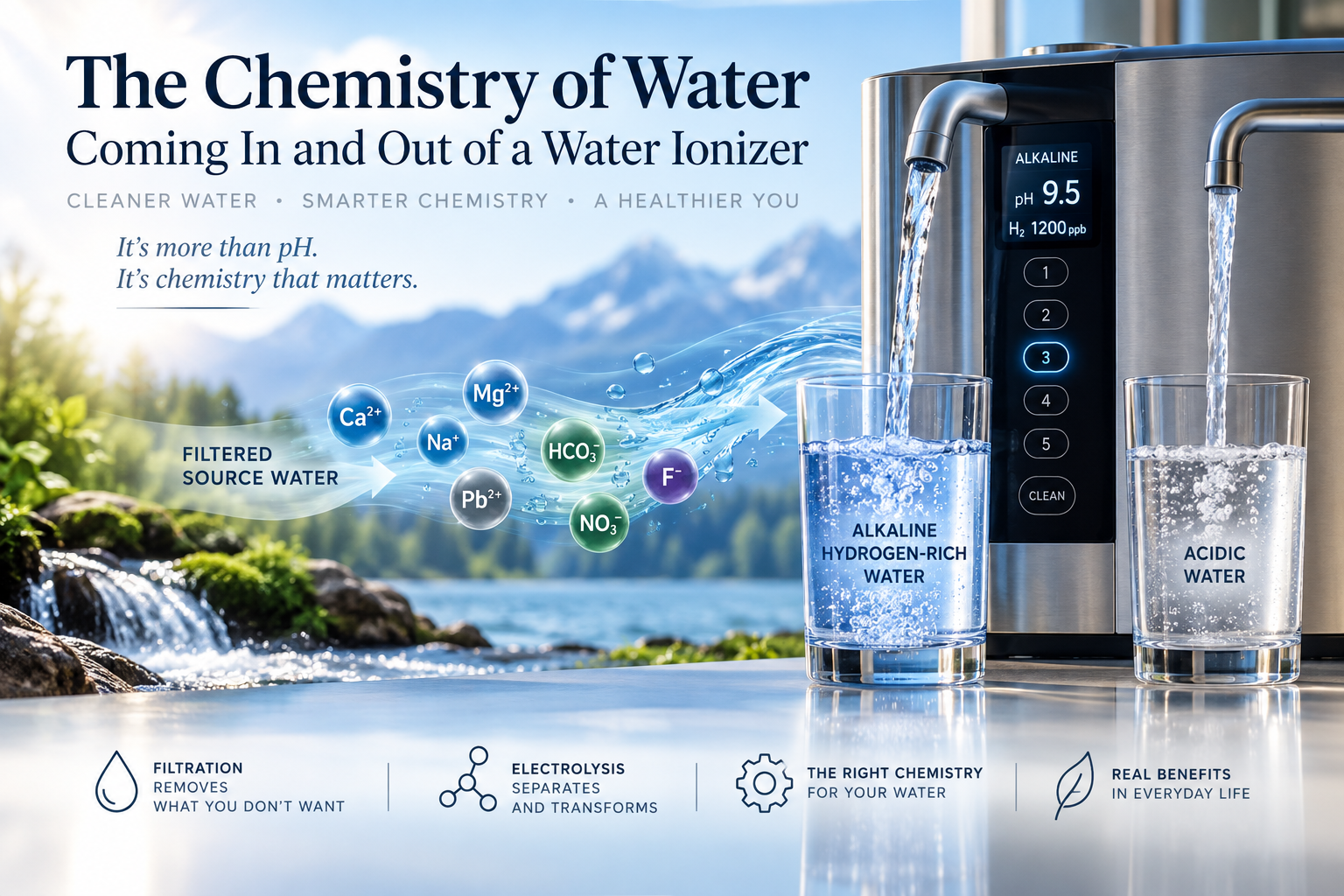
The Chemistry of Water Coming In and Out of a Water Ionizer
Quite a bit is happening inside a water ionizer. This page answers many questions about water ionization that are rarely explained. Here is just a sampling:
- Your source water matters. The minerals and other substances dissolved in your water affect how readily it can be ionized. During electrolysis, charged substances (ions) naturally present in the water tend to move toward one pole or the other. This can affect the chemistry of the drinking water that comes out.
- Your water affects the machine, too. Source-water chemistry can influence how a water ionizer performs and its condition over time.
- Bigger is not necessarily better. More plates, stronger settings and bigger numbers do not automatically produce better drinking water.
I have never believed that choosing or using a water ionizer is simply a matter of looking for the most plates, the highest pH, the highest H2 levels or the strongest setting. Those numbers can be useful, but maximizing them should not be the goal.
The goal is not maximum. The goal is the right water chemistry for the job.
First Things First: Filtration Comes Before Ionization
Before water reaches the electrolysis chamber, I want as many unwanted contaminants removed as possible.
This is especially important because electrolysis does not know the difference between a mineral we want and a contaminant we do not want. It responds largely to chemistry and electrical charge.
For example:
- Calcium and magnesium are positively charged minerals that are normally desirable in drinking water and also help water conduct electricity.
- Lead, cadmium, copper and some other unwanted metals can also exist as positively charged ions.
- Fluoride and nitrate are negatively charged ions.
- Many organic contaminants may be electrically neutral and therefore are not predictably moved to one side simply by electrolysis.
This is one reason I put so much emphasis on high-quality filtration before the water is ionized. Electrolysis can change what happens to substances that remain in the water, but it should never be used as an excuse for inadequate filtration.
What Actually Happens During Electrolysis?
A water ionizer separates water through an electrolysis chamber containing positively and negatively charged electrodes, usually separated by membranes.
Three important things can happen at the same time:
1. Charged Ions Move
Positively charged ions, called cations, tend to migrate toward the cathode, where the alkaline water is produced.
Negatively charged ions, called anions, tend to migrate toward the anode, where the acidic water is produced.
That means minerals such as calcium and magnesium generally favor the alkaline side, while negatively charged ions such as chloride, nitrate, sulfate and fluoride tend toward the acidic side.
2. The pH Changes Dramatically Near the Electrodes
The cathode produces a strongly alkaline local environment, while the anode produces a strongly acidic and oxidizing environment.
Those changing conditions can affect the chemical form, solubility and behavior of substances in the water.
3. Electrode Reactions Occur
Water itself participates in electrochemical reactions. Hydrogen gas is produced at the cathode, which is the source of the dissolved molecular hydrogen found in freshly ionized alkaline water.
Other reactions can also occur depending upon what ions are present in the source water and how strongly the machine is being driven.
Fluoride, Nitrate and Other Negatively Charged Ions
One particularly interesting part of water-ionizer chemistry is what happens to negatively charged contaminants.
Fluoride exists primarily as the negatively charged fluoride ion, F−. During electrolysis, its electrical charge gives it a tendency to migrate toward the anode and the acidic-water side.
Nitrate, NO3−, behaves similarly in principle.
Electrodialysis research confirms that electrically driven membrane systems can separate fluoride and nitrate ions. Exactly how much additional separation takes place inside any particular household water ionizer depends on many variables, including:
- source-water chemistry,
- electrode and membrane design,
- electrical current and voltage,
- flow rate,
- competing ions, and
- how strongly the machine is being operated.
So one shouldn't claim that ionization alone should be relied upon to remove fluoride or nitrate. That is the job of appropriate filtration.
However, once good filtration has already reduced these substances, their negative electrical charge gives us another interesting reason to consider what happens to the remainder during electrolysis.
Positive Ions Make Good Filtration Especially Important
The opposite side of this chemistry is just as important.
Calcium and magnesium are beneficial positively charged minerals and tend toward the cathode and alkaline-water side.
But some undesirable dissolved metals can also exist as positively charged ions.
Electrolysis does not make a moral decision about which positively charged ion is “good” and which is “bad.”
That is another reason I want unwanted metals removed as completely as practical before electrolysis begins.
The water ionizer can then work primarily with the desirable mineral ions that remain.
Not Everything in Water Is Strongly Affected by Electrical Charge
Some contaminants are neutral molecules rather than positively or negatively charged ions.
Many VOCs, pesticides, disinfection byproducts and other organic substances therefore do not simply migrate neatly to the acidic or alkaline side because of electrolysis.
That is why multi-media filtration is so important.
Different filtration materials perform different jobs. Some physically block particles. Some adsorb chemicals onto enormous microscopic surfaces. Others use ion exchange or specialized media to target particular dissolved substances.
Electrolysis is not a substitute for these processes. It comes after them.
Hard Water: Helpful for Ionization, but Too Much Can Cause Scale
Calcium and magnesium are valuable minerals in drinking water, and because they are dissolved ions, they also help water conduct electricity. This is one reason moderately mineralized water can ionize very well.
But once again, more is not automatically better.
Calcium ions are attracted toward the cathode, where the alkaline water is being produced. The immediate environment around that electrode can reach a much higher pH than the finished water coming from the faucet.
Those conditions encourage calcium carbonate and other mineral deposits to form.
This helps explain why scale tends to become an issue around the cathodic/alkaline pathway of a water ionizer.
Over time, excessive scale can interfere with water flow and electrochemical performance.
One practical sign I watch for is a gradual reduction in alkaline-water flow. Depending on the machine and water conditions, mineral cleaning with a manufacturer-approved citric-acid procedure may periodically be needed.
This can happen even when the incoming water is perfectly acceptable drinking water. Very hard water simply requires more attention.
Water Softening Creates a Very Different Kind of Water
A conventional whole-house ion-exchange softener removes much of the calcium and magnesium responsible for hardness and replaces those ions primarily with sodium.
The harder the original water, the more sodium may be added during this exchange.
This solves one problem—scale throughout the home—but creates a different source-water chemistry for a water ionizer.
The resulting water may contain very little calcium or magnesium while still containing plenty of dissolved ions and therefore plenty of electrical conductivity.
Soft water is not necessarily low-TDS water.
This is why I generally do not consider heavily sodium-softened water ideal feed water for a water ionizer.
For homes with very hard water that require a whole-house softener, tankless reverse osmosis installed after the softener, followed by appropriate remineralization, can be a better approach for drinking water and for supplying a water ionizer.
The RO removes much of the excessive sodium and other dissolved salts. Remineralization then restores an appropriate amount of useful mineral content so the water can again ionize effectively.
Why Saline Makes Such a Dramatic Difference During Electrolysis
Some water ionizers provide an especially revealing example of just how important dissolved salts are to electrolysis.
Machines designed to produce extremely alkaline and extremely acidic water sometimes include a saline or electrolysis-enhancer port.
Why add saline?
Because saline water is highly conductive.
Sodium chloride separates into highly mobile Na+ and Cl− ions in water. Those ions carry electrical current extremely well and allow the electrolysis process to produce much more extreme chemical conditions than ordinary drinking water normally would.
This is why certain machines use added saline when producing specialized strong alkaline and strong acidic waters for cleaning or sanitizing rather than drinking.
Strong Alkaline Cleaning Water
On the cathode side, powerful electrolysis creates a very high concentration of hydroxide ions and an extremely high pH.
This kind of water can be useful for breaking up oils, grease and stubborn soils.
But pH 11 or higher water should not be thought of as “extra-good alkaline drinking water.” It is chemically different water intended for a different purpose.
Strong Acidic Disinfecting Water
The anode side is even more interesting when chloride is present.
Chloride can participate in electrochemical reactions that produce active chlorine chemistry, including hypochlorous acid under appropriate conditions.
Hypochlorous acid is a powerful antimicrobial substance. This helps explain why properly produced acidic electrolyzed water has been used for sanitizing and disinfecting applications.
Its usefulness is therefore not simply because “the pH is very low.” Its chemistry is different from ordinary acidic water.
Why I Don't Personally Chase Extreme Water Settings
I have worked with and tested water ionizers for many years, but I have never personally focused on trying to produce the most extreme alkaline or acidic water possible.
I have found the benefits I am interested in at ordinary drinking-water levels.
If I simply want more acidic water for an ordinary household purpose, there are easy ways to lower the pH—for instance, adding a little vinegar or lemon juice.
That is not chemically identical to saline-enhanced electrolyzed disinfecting water, particularly when hypochlorous acid is involved. But for many routine household uses, I simply have no reason to push my water ionizer to its most extreme electrochemical conditions.
Different waters have different purposes.
Salinity Also Raises Questions About the Machine Itself
The saline-enhancer feature demonstrates something consumers often overlook:
The chemistry of the source water doesn't just affect the water coming out. It affects the electrolysis chamber too.
Higher concentrations of dissolved ions change conductivity and change the electrochemical environment at the electrodes.
That does not mean that sodium itself simply “corrodes platinum,” and I would not make that claim.
Platinum-coated titanium is used precisely because platinum is an excellent electrocatalyst and the electrode system is designed to withstand demanding electrochemical conditions.
However, electrode condition still matters over the long term. Source-water chemistry, mineral deposits, electrical conditions, operating strength and years of use can all influence electrochemical surfaces.
This is one reason I don't consider “the more conductivity, the better” to be a good rule for everyday water-ionizer use.
The intentional use of saline for occasional specialized strong-water production is very different from continuously feeding a drinking-water ionizer unusually saline or sodium-rich source water every time it runs.
Platinum Is Much More Than an Expensive Coating
The platinum used on quality water-ionizer electrodes isn't there merely to protect the titanium beneath it.
Platinum is one of the world's most effective catalysts for the hydrogen-evolution reaction.
In plain English, the platinum surface helps make the electrochemical production of molecular hydrogen much more efficient.
That is one reason the quality, design and condition of the electrode surface matter.
A machine may still turn on, produce alkaline water and appear to operate even though its electrochemical performance has changed with age, scaling or electrode condition. The lights and pH setting alone do not tell us everything about what is happening on the electrode surface.
An Interesting Area of Platinum Research
Researchers have also detected tiny quantities of nanoscale platinum in some experimentally produced electrolyzed hydrogen waters made with platinum-coated electrodes.
Because nanoscale platinum is highly catalytically active, researchers have investigated whether these particles might contribute additional antioxidant, health benefits or hydrogen-related catalytic effects.
Some laboratory studies are intriguing, but this research is still developing. It has not been established that ordinary flow-through household water ionizers release enough nano-platinum to produce a meaningful health effect.
I therefore consider this an interesting area of research rather than a reason to buy or recommend a particular water ionizer.
More Plates Doesn't Automatically Mean Better Water
Another place where I think the water-ionizer industry has encouraged consumers to chase numbers is electrode plate count.
Over the years, I have personally tested water ionizers with 5, 7, 9, 13 and more plates.
One thing became very clear to me:
More plates did not automatically produce better water.
With my own source water, I have repeatedly found a sweet spot around seven plates. In softer-water areas, I have generally found that something closer to nine plates can be advantageous.
Those numbers should not be interpreted as a universal rule. Electrode size, total effective surface area, power supply, flow rate, cell design and source-water chemistry all matter.
Two seven-plate machines can be very different electrochemically.
That is why I don't recommend buying a water ionizer simply by counting plates.
You're not buying plates. You're buying the water the machine produces from the water you actually have.
The Highest Alkaline Setting Isn't Automatically the Best One Either
My own water ionizer has five alkaline settings.
For everyday drinking, I naturally gravitate toward Level 3. That is simply the water that feels best to me.
I don't regard Levels 4 and 5 as goals that I should somehow work my way toward simply because the machine offers them.
Another person's source water may be completely different, so Level 3 on my machine and water source is not necessarily equivalent to Level 3 in another home.
The point is not that everyone should drink Level 3.
The point is:
A higher setting is an option, not an achievement.
The Same Principle Applies to Molecular Hydrogen
Molecular hydrogen, H2, has attracted enormous interest in recent years, and understandably so. Research into hydrogen-rich water and molecular hydrogen continues to expand.
But I think another “more is always better” mentality has grown up around hydrogen concentration.
The biology of molecular hydrogen appears to be much more sophisticated than the simple idea that one H2 molecule neutralizes one harmful oxygen radical.
Research increasingly points toward effects involving cellular signaling, redox regulation, inflammatory pathways, mitochondrial responses and the body's own protective systems.
This is important because signaling biology does not necessarily follow a simple equation such as:
twice as much H2 = twice as much benefit.
Current research does not establish such a straightforward dose-response relationship.
That doesn't mean hydrogen concentration is irrelevant. It means that the biggest number on a meter should not automatically be interpreted as the healthiest water.
Molecular hydrogen also does not accumulate indefinitely in the body. It normally diffuses within a few days.
My Own Experience With Hydrogen Water
I drink a combination of alkaline ionized water and neutral hydrogen water every day.
In my own experience, I can feel the benefits just as well when drinking about four liters per day as I can when drinking two gallons.
That is my personal observation, not a universal dosage recommendation.
But it has reinforced something I have observed repeatedly over the years:
I don't need to chase the maximum number to feel the benefit.
Learning to Pay Attention to Your Own Body
Over the years, I have encouraged my customers to pay attention to how their own bodies respond—not only to ionized water, but to the things they eat and drink in general.
I believe this kind of awareness can be developed.
Who is in a better position than you are to notice how you feel from day to day, especially as your own perception of well-being becomes more refined?
Some things require objective measurement. You cannot feel whether a laboratory detected fluoride at a certain concentration or whether a filter reduced a particular contaminant to non-detectable levels.
But laboratory measurements cannot tell you how you personally feel after drinking one type of water versus another.
Both kinds of information have value, and they answer different questions.
This is one reason I encourage people to become observant rather than assuming that the largest number shown on a specification sheet must automatically be better for them.
The Goal Isn't Maximum. It's the Sweet Spot.
After many years of working with water ionizers, I keep coming back to the same principle.
- Too little mineral content can make water difficult to ionize effectively.
- Too much hardness can encourage calcium and magnesium scale.
- Excessive sodium-softened water can provide plenty of conductivity while having an undesirable mineral balance for drinking and electrolysis.
- More plates do not automatically mean better water.
- A higher alkaline setting does not automatically mean better drinking water.
- Extremely high pH can be useful for cleaning but is not simply “better alkaline drinking water.”
- Higher hydrogen concentration has not been shown to produce proportionally greater biological benefit.
- More electrical conductivity makes electrolysis easier, but that does not mean increasingly saline source water is desirable.
With water ionization, more isn't always better. Balance matters.
The Water Affects the Ionizer, Too
One of the most overlooked lessons in water ionization is that the relationship works in both directions.
The ionizer changes the water.
But the water also affects the ionizer.
Hardness can contribute to cathodic scale. Source-water mineral composition affects conductivity. Excessive dissolved salts alter the electrochemical environment. Flow rate changes electrolysis exposure time. Stronger electrical settings change what happens around the electrodes.
All of these factors can influence not only the water you produce today but also how the electrolysis system performs over years of use.
That is why I believe the best water-ionizer setup starts with understanding the water entering the machine.
Think of the Water and the Ionizer as One System
There really is no single “best” water ionizer independent of the water being fed into it.
A well-designed system considers:
- the chemistry of the source water,
- hardness and mineral balance,
- contaminants that should be removed before electrolysis,
- the quality and design of the filtration system,
- electrode design and effective surface area,
- electrical control and flow rate,
- the amount of ionization actually needed, and
- long-term maintenance of the electrolysis chamber.
This is why I have always preferred actually testing water ionizers rather than judging them from specification sheets alone.
A machine with more plates, a higher advertised pH or a bigger hydrogen number may sound impressive.
But those numbers do not answer the most important question:
What kind of water does this machine produce from the water you actually have?
That is the question that matters.