
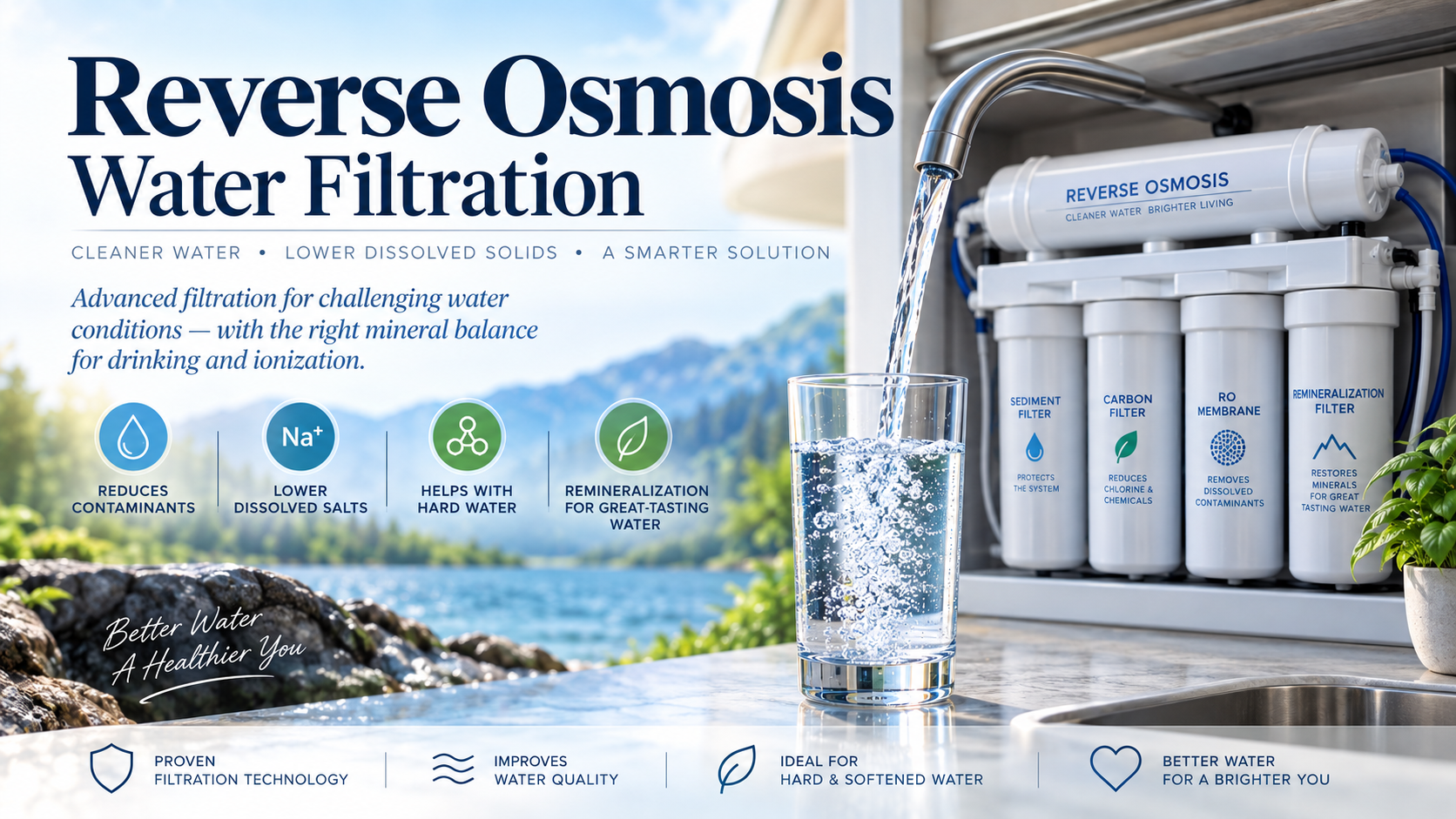
Reverse Osmosis Water Filtration
Reverse osmosis (RO) is one of the most effective ways to broadly reduce dissolved substances in water. Unlike filters designed to selectively remove contaminants while retaining most naturally occurring minerals, reverse osmosis uses a specialized membrane to substantially reduce both unwanted contaminants and dissolved minerals.
That doesn't make reverse osmosis inherently better or worse than other forms of water filtration. The best filtration method depends on the chemistry of the water you're starting with and what you need the finished water to accomplish.
For water-ionizer users, reverse osmosis can be particularly valuable when dealing with extremely hard water, sodium-softened water, excessive dissolved salts, or other source-water conditions that make direct ionization less desirable. Whether or not RO water will be used with a water ionizer, proper remineralization is an important part of the system.
How Does Reverse Osmosis Work?
Reverse osmosis uses pressure to move water across a highly selective membrane. Water molecules pass through much more readily than many dissolved substances, leaving a purified-water stream on one side and a concentrate stream containing rejected substances on the other.
It is sometimes described as though an RO membrane were simply an extremely fine screen with tiny holes. That's an easy way to visualize it, but the actual chemistry is more sophisticated. Membrane rejection depends on factors including molecular and ionic properties, electrical charge, hydration, membrane chemistry, pressure and the composition of the incoming water.
This is why RO can substantially reduce very small dissolved ions such as sodium, nitrate and fluoride. They don't simply pass through because they are "smaller than the holes."
What Does Reverse Osmosis Remove?
A properly designed reverse osmosis system can substantially reduce a remarkably broad range of dissolved substances. Depending on the system and source water, these may include:
- Sodium and other dissolved salts
- Calcium and magnesium hardness
- Nitrate and nitrite
- Fluoride
- Arsenic
- Lead and many other heavy metals
- Hexavalent chromium (Chromium-6)
- Many PFAS compounds
- Many other dissolved inorganic contaminants
RO systems generally use other filtration technologies along with the membrane. Sediment filtration helps protect the system, while activated carbon is particularly useful for substances such as chlorine, chloramine and many organic chemicals. For that reason, the performance of the complete RO system matters more than the membrane alone.
Reverse Osmosis vs. Mineral-Retaining Filtration
This is one of the most important distinctions between reverse osmosis and the type of advanced filtration we use with our UltraWater filtration systems.
UltraWater is designed to target a broad range of unwanted contaminants while retaining the naturally occurring dissolved minerals that are useful in drinking water and especially useful for electrolysis.
Reverse osmosis takes a different approach. It broadly reduces dissolved substances, including both unwanted contaminants and minerals such as calcium and magnesium.
Neither approach is automatically better for every water supply. The source water should help determine the treatment.
When Is Reverse Osmosis a Particularly Good Choice?
There are some source-water conditions where the broad reduction provided by reverse osmosis can be a real advantage.
After a Whole-House Water Softener
A conventional ion-exchange water softener removes calcium and magnesium hardness by exchanging those minerals primarily for sodium. The harder the original water, the more sodium may be added during this process.
Reverse osmosis installed after the softener can substantially reduce that added sodium along with many other dissolved substances. This can make RO particularly useful for producing drinking water in homes that require a whole-house softener.
Extremely Hard Water
Calcium and magnesium aren't automatically undesirable. In fact, they provide useful mineral content and electrical conductivity for a water ionizer.
But there can be too much of a good thing.
Excessive hardness can contribute to scale formation inside a water ionizer. Electrolysis creates very high-pH conditions immediately around the cathode, which can encourage calcium carbonate and other mineral deposits to form.
For homes with extremely hard water, RO can provide a way to remove most of that excessive mineral load and then add back a more appropriate amount through remineralization.
High Dissolved Solids or Challenging Source Water
RO may also be appropriate when source water contains excessive dissolved salts or particular contaminants for which membrane separation provides an important advantage.
This is why I don't believe water treatment should begin with the assumption that one filtration technology is best for everybody. It should begin with the water.
Reverse Osmosis and Water Ionizers
If reverse osmosis removes minerals so effectively, how can RO water be used with a water ionizer?
The answer is remineralization.
Electrolysis depends on dissolved ions to carry electrical current through the water. Very low-mineral RO water has low conductivity and may therefore ionize poorly.
When RO water is going to supply a water ionizer, an appropriately designed remineralization stage can restore useful mineral content and improve the conductivity needed for effective electrolysis.
A particularly useful arrangement for very hard water that requires a whole-house sodium-based softener can be:
Hard Source Water → Whole-House Softener → Reverse Osmosis → Remineralization → Water Ionizer
Each stage has a different job. The softener protects the home's plumbing and appliances from excessive hardness. RO then substantially reduces the sodium added by the softener along with other dissolved substances. Remineralization adds back an appropriate amount of useful mineral content before the water reaches the ionizer.
The goal isn't to remove every mineral possible. The goal is to create the right water chemistry for what comes next.
Traditional RO vs. Tankless Reverse Osmosis
Traditional residential reverse osmosis systems usually produce purified water relatively slowly and store it in a pressurized tank until it is needed.
Modern tankless reverse osmosis systems can produce water much more quickly, allowing purified water to be supplied on demand without a conventional RO storage tank. Modern high-efficiency designs can also produce substantially less concentrate water than many older RO systems.
This newer technology is one reason my view of reverse osmosis has evolved over the years. Today's better-designed tankless systems give us options that weren't as practical with many older residential RO systems.
Choosing Between UltraWater and Reverse Osmosis
If your source water already contains a desirable mineral balance, I generally prefer filtration that removes the contaminants we don't want while retaining useful naturally occurring minerals.
But if the source water is excessively hard, sodium-softened, unusually high in dissolved salts, or otherwise better suited to broad dissolved-solids reduction, reverse osmosis may be the better approach.
That's why we offer both technologies.
For a detailed side-by-side look at the two approaches, see UltraWater Filtration vs. Tankless Reverse Osmosis.
And if you're using either type of filtration with a water ionizer, I strongly recommend reading The Chemistry of Water Coming In and Out of a Water Ionizer. It explains why minerals, hardness, sodium, conductivity, filtration and electrolysis all have to be considered together.
There isn't one perfect filtration method for every water supply. There is a best approach for the water you actually have.