Experience a Healthier Way to Take a Bath
Published by Alkaline Water Plus
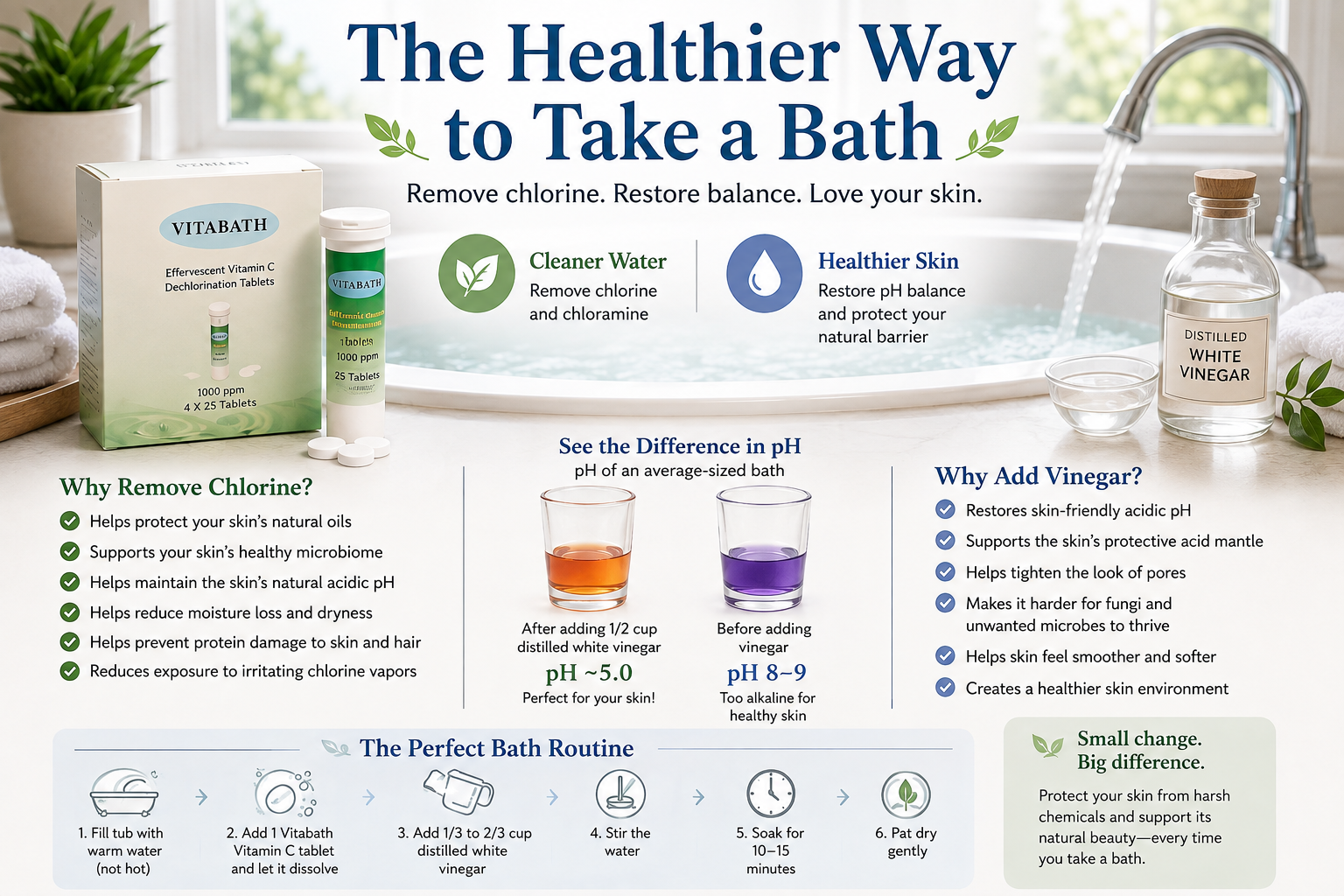
Experience the Healthier Way to Take a Bath
Remove Chlorine. Restore Balance. Love Your Skin.
Most people think of a bath simply as a way to relax. But an ordinary bath can also expose your entire body to chlorinated water for ten, fifteen, or twenty minutes at a time.
Chlorine helps disinfect municipal water, but it can also strip away the natural oils that protect your skin, contribute to dryness and irritation, and disturb the slightly acidic environment healthy skin needs.
Fortunately, you can create a much more skin-friendly bath with two simple additions:
- One Vitabath Vitamin C Dechlorination Tablet to neutralize chlorine and chloramine
- Approximately 1/3 to 2/3 cup of distilled white vinegar (depends on the size of your bath) to bring the water closer to your skin’s naturally acidic pH
Why Remove Chlorine From Your Bath?
A bath gives chlorinated water prolonged contact with nearly your entire body. For people with dry, sensitive, itchy, or easily irritated skin, removing the chlorine may make a noticeable difference. Or better yet, remove the chlorine BEFORE your skin gets dry, sensitive or itchy.
Did you know your skin is part of your immune system? Think of your skin as a castle wall that protects your body from outside invaders like germs and dirt. Because it acts instantly to block everything, it is a key part of your body's "innate" (natural-born) defense system. To keep this wall strong, your skin relies on a slightly acidic chemical shield, called the acid mantle. Bathing in water that is chlorine-free and slightly acidic keeps this shield intact, preventing your skin from drying out and ensuring the "bricks" of your castle wall stay tightly packed together.
Your hair benefits just as much as your skin. While your skin is like a castle wall, each strand of your hair is protected by a shield that looks like shingles on a roof. Harsh chlorine and alkaline water force these shingles to swell and stand wide open, letting vital moisture escape and leaving your hair dry, frizzy, and brittle. On the other hand, bathing in chlorine-free, slightly acidic water causes those shingles to contract and lay perfectly flat. When your hair's protective shield stays tightly closed, it traps moisture inside, reduces breakage, and reflects light to give your hair a smooth, healthy shine.
Chlorine Can Strip Away Protective Oils
Your skin depends on a natural layer of oils and lipids to hold in moisture and help keep irritants out. Chlorine is an oxidizing disinfectant that can remove some of these protective oils.
Once the barrier is weakened, moisture escapes more easily, leaving the skin feeling tight, dry, rough, or uncomfortable.
It Can Disturb the Skin’s Natural Microbiome
Healthy skin is home to a community of beneficial microorganisms. This microbiome helps support the skin barrier and defend against unwanted organisms.
Because chlorine is a broad disinfectant, repeated exposure may disturb this natural balance.
It Can Disrupt the Skin’s Natural pH
Healthy skin is not neutral or alkaline. Its protective surface, often called the acid mantle, is normally slightly acidic, with a pH of approximately 4.5 to 5.5.
Tap water, soaps, and cleansers can temporarily raise the skin’s pH. This may interfere with the enzymes and natural processes involved in maintaining and repairing the skin barrier.
It Can Affect Skin and Hair Proteins
Repeated exposure to chlorinated water may contribute to rough-feeling skin, dry hair, and increased brittleness by affecting natural oils and structural proteins such as keratin.
Hot Water Can Release Irritating Vapors
Hot, steamy water can increase the release of chlorine-related vapors into the bathroom air. Some people with asthma, allergies, or sensitive airways may find these vapors irritating.
An Easy Way to Dechlorinate Your Bath
Vitabath Vitamin C Dechlorination Tablets provide a quick and convenient way to remove chlorine and chloramine from bath water.
The specially formulated vitamin C reacts with these disinfectants and neutralizes them before you soak.
One tablet is suitable for most baths.
Shop Vitabath Vitamin C Dechlorination Tablets
Why Add Distilled White Vinegar?
After removing the chlorine, a small amount of distilled white vinegar can help bring the bath water closer to the naturally acidic environment your skin prefers.
Vinegar contains acetic acid and has natural antimicrobial properties. A mildly acidic bath may also create a less favorable environment for unwanted bacteria, fungi, and yeasts.
Adding vinegar may help:
- Support the skin’s protective acid mantle
- Bring bath water closer to a skin-friendly pH
- Reduce the tight, dry feeling that can follow bathing
- Leave skin feeling smoother and softer
- Support a healthy skin environment
- Reduce enlarged pores temporarily
See the Difference in pH
The photograph below shows a simple pH comparison using water from an average-sized bath.
The sample on the right shows the bath water before distilled white vinegar was added. The sample on the left shows the water after adding approximately 1/2 cup of distilled white vinegar.

The color change demonstrates how a modest amount of vinegar can shift the water from a more alkaline pH toward the mildly acidic range naturally preferred by healthy skin.
Left: bath water after adding 1/2 cup of distilled white vinegar. Right: bath water before adding vinegar.
How to Prepare a More Skin-Friendly Bath
- Fill the tub with comfortably warm water.
Avoid extremely hot water, which can remove protective oils and increase moisture loss. - Add one Vitabath Vitamin C tablet.
Allow it to dissolve and circulate through the water for approximately one minute. - Add distilled white vinegar.
Use approximately 1/3 to 2/3 cup, depending on the size of the bath. For an average-sized bath, about 1/2 cup is a practical starting amount. - Stir the bath water.
Move the water around to distribute the vitamin C and vinegar evenly. - Soak for approximately 10 to 15 minutes.
- Pat your skin dry gently.
Avoid vigorous rubbing, especially if your skin is already dry or sensitive.
Should You Rinse Afterward?
A full rinse is not necessary. This bath is the perfect rinse.
Important Bath Precautions
- Do not apply undiluted vinegar directly to the skin.
- Use less vinegar if your skin is highly sensitive.
- Keep vinegar away from the eyes.
- Never combine vinegar with chlorine bleach or bleach-containing products.
Will it Work in a Hot Tub?
Hot tubs are meant to be chlorinated to keep the water sanitized for long periods, such as weeks or months. That being said, you could add bath tablets several minutes before you plan to use it and then as soon as you got out you'd have to re-chlorinate it. Keep in mind that a single bath tablet dechlorinates about 50 gallons, or one bath, and a hot tub has 250 gallons or so of water in it. So, in my case I'd add 5 tablets to my spa, and I would not forget to re-chlorinate it once I got out.
Healthy Skin Begins With the Water That Touches It
Good skin care is not about what you apply after bathing. It involves reducing unnecessary stress on the skin while you bathe.
Removing chlorine helps protect the skin’s natural oils and microbiome. Restoring a mildly acidic pH helps support the acid mantle and the skin’s own protective barrier.
This simple combination can transform an ordinary bath into a more comfortable and skin-supportive part of your natural health routine.
Small change. Big difference.
Click here to learn more about Vitabath Vitamin C Dechlorination Tablets.