Tyent ACE-13 vs AlkaViva Vesta H2 Head-to-Head Comparisons
Published by Alkaline Water Plus
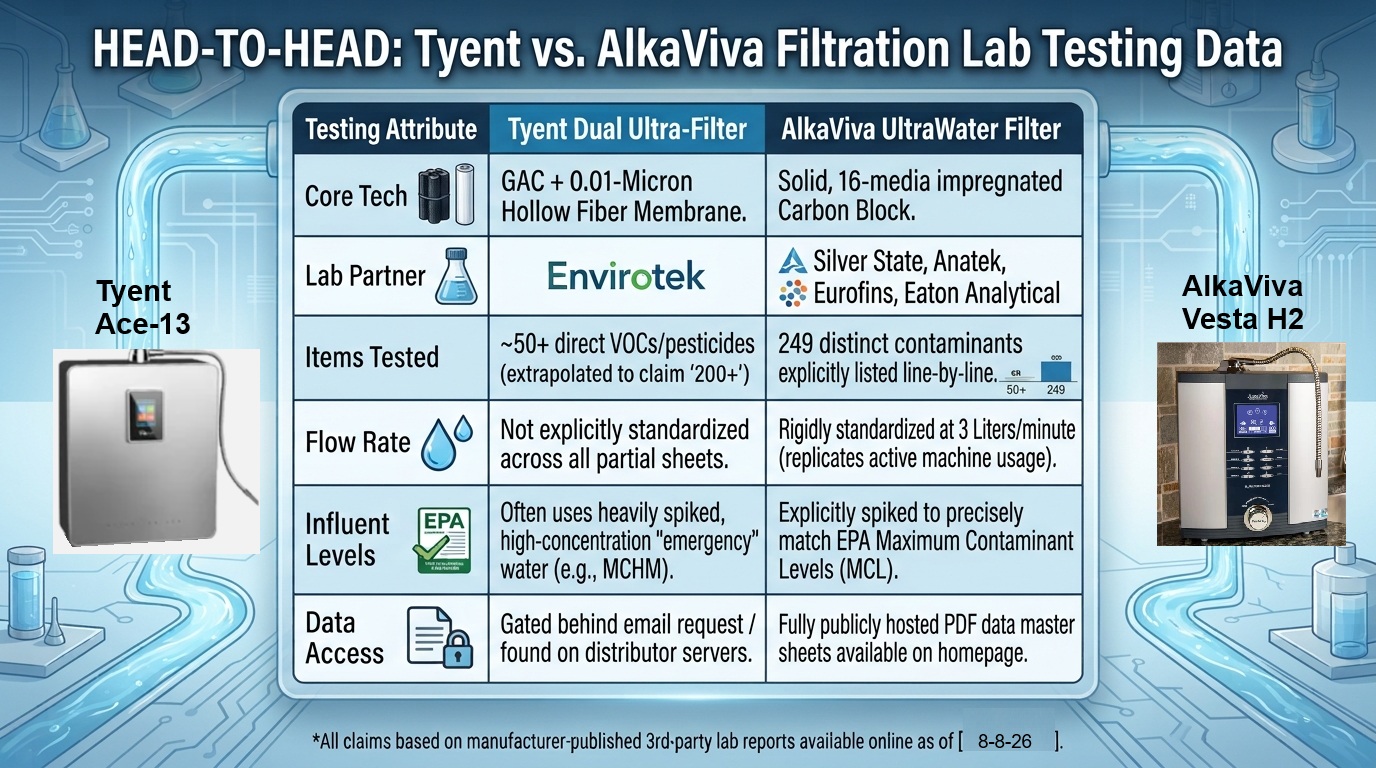
Which water ionizer performs better—the Tyent ACE-13 or the AlkaViva Vesta H2? Both are premium water ionizers designed to produce alkaline, hydrogen-rich drinking water. Both offer multiple water settings and advanced filtration systems. But how do they compare when tested side by side?
I recently tested both machines using my local St. Louis, Missouri, water supply. Rather than testing their maximum output settings, I wanted to compare their performance at a level I would actually use for everyday drinking water.
For this comparison, I selected Level 3 on both machines and adjusted their flow rates to approximately 1.5 liters per minute.
I measured three important characteristics of the water produced by each machine:
- pH: The acidity or alkalinity of the water.
- ORP (Oxidation-Reduction Potential): An electrochemical measurement expressed in millivolts (mV).
- Dissolved Molecular Hydrogen (H2): The concentration of hydrogen gas dissolved in the water.
I also examined the filtration technology and independent laboratory testing behind each brand. After all, producing hydrogen-rich alkaline water is only part of what makes a water ionizer worth owning.
Side-by-Side Testing: Tyent ACE-13 vs. AlkaViva Vesta H2
The following table summarizes the results I observed during my demonstration.
| Test | Tyent ACE-13 | AlkaViva Vesta H2 |
|---|---|---|
| Drinking Setting | Level 3 | Level 3 |
| Flow Rate | 1.5 L/min | 1.5 L/min |
| Alkaline Water pH | 9.5 | 9.5 |
| Acidic Water pH | 4.5 | Approximately 4.0 |
| ORP | -670 mV | -769 mV |
| Trustlex H2 Meter Display | 1.396 | Over 1.5 |
These results demonstrate some interesting differences between the two machines, particularly in ORP and the hydrogen meter readings.
These measurements represent the performance of these particular machines under my local water conditions. Results may vary with water chemistry, temperature, mineral content, maintenance, and other factors.
Tyent ACE-13: My Testing Results
I began with the Tyent ACE-13, selecting Level 3 for drinking water.
The alkaline water measured approximately 9.5 pH, while the acidic water measured approximately 4.5 pH.
Next, I tested the alkaline water's ORP and obtained a reading of approximately -670 mV. This is a strongly negative ORP reading.
Finally, using my Trustlex H2 meter, I obtained a display reading of 1.396.
Overall, the Tyent ACE-13 demonstrated substantial electrolysis performance under these testing conditions.
AlkaViva Vesta H2: My Testing Results
Next, I tested the AlkaViva Vesta H2 using the same St. Louis water supply, the same Level 3 drinking-water setting, and approximately the same flow rate.
The alkaline water measured 9.5 pH, matching the Tyent ACE-13.
The acidic water measured approximately 4.0 pH, somewhat lower than the Tyent's acidic output.
The Vesta H2 also produced a more negative ORP reading of approximately -769 mV, compared with the Tyent's -670 mV.
Finally, the Trustlex H2 meter displayed a reading above 1.5, exceeding the reading observed with the Tyent.
Why Water Filtration Is Just as Important as Electrolysis
Many consumers focus almost entirely on how much hydrogen a water ionizer produces or how high its alkaline pH can reach.
But there is another critically important consideration: What contaminants are being removed from the water before you drink it?
Water ionizers do not automatically remove contaminants simply because they raise pH or produce molecular hydrogen. Effective filtration is a separate and essential function.
Both Tyent and AlkaViva recognize this, and both use dual-filter systems.
However, their filtration technologies and the documentation supporting their performance claims differ.
Comparing Tyent and AlkaViva Filtration Technology
Tyent ACE-13 Filtration
The Tyent ACE-13 uses a dual-filter arrangement incorporating granular activated carbon (GAC) and a fine filtration component described in the manufacturer's materials.
Tyent advertises broad contaminant reduction capabilities and references independent laboratory testing.
In researching its filtration performance, I found that the publicly accessible documentation did not provide the same level of detail as the AlkaViva reports I reviewed.
Tyent indicates that additional laboratory reports may be available upon request.
This does not necessarily mean that Tyent's filters perform poorly. In fact, I consider Tyent's filtration technology competitive with many other water ionizer brands.
But for consumers who want to independently examine the testing procedures, contaminant concentrations, and actual reduction results, the accessibility and completeness of laboratory reports matter.
AlkaViva Vesta H2 UltraWater Filtration
The AlkaViva Vesta H2 incorporates the company's proprietary UltraWater filtration technology, using a specialized carbon-block system with multiple filtration media.
One of the reasons I consistently recommend AlkaViva is its commitment to independent laboratory testing and detailed reporting.
AlkaViva's published laboratory documentation identifies 249 contaminants evaluated, including many substances of concern in municipal drinking water.
The testing was conducted by Silver State Analytical Laboratories, an independent laboratory with relevant environmental testing credentials.
An especially important feature of the testing is that the reported filtration conditions include a flow rate of approximately 3 liters per minute, representative of water flowing through an operating water ionizer.
This matters because filtration performance can change with flow rate. A filter that performs well when water moves very slowly may not achieve identical results under normal household use.
The AlkaViva reports also document the concentrations of contaminants introduced into the test water and the concentrations detected after filtration.
For many contaminants, the post-filtration results were reported as below the laboratory's detection or reporting limits.
These details make the testing considerably more useful to consumers who want to understand the evidence behind the filtration claims.
Important distinction: A result reported as nondetect does not necessarily mean absolute zero contamination. It means the substance was not detected above the laboratory's specified analytical limit.
Review AlkaViva's UltraWater Laboratory Testing Documentation »
Independent Laboratory Testing: Why Transparency Matters
When evaluating water ionizers, I look beyond the number of contaminants a manufacturer claims its filters can remove.
I want to know:
- Which specific contaminants were actually tested?
- What concentrations were introduced into the incoming water?
- What was the water flow rate during testing?
- Were the results obtained from independent laboratory analysis?
- Were filter performance and capacity evaluated under documented conditions?
- Can consumers review the actual laboratory reports?
A claim that a filter reduces hundreds of contaminants is much more meaningful when supported by detailed, accessible testing records.
AlkaViva has made substantial documentation available for its UltraWater technology, and that transparency is a major reason I favor the brand.
For Tyent, I encourage consumers to request the complete current laboratory reports and compare the testing conditions directly.
Does a More Negative ORP Mean More Hydrogen?
This is an important distinction.
Both machines produced strongly negative ORP readings during my testing, with the Vesta H2 showing the more negative result.
Dissolved molecular hydrogen can contribute to negative ORP readings, but ORP also depends on pH, electrode behavior, and other aspects of water chemistry.
Consequently, a more negative ORP does not automatically prove a higher dissolved hydrogen concentration.
For meaningful hydrogen comparisons, I prefer direct dissolved-hydrogen testing using an appropriately calibrated instrument with a verified measurement range.
This is why I included both ORP and hydrogen meter testing in my demonstration rather than relying on ORP alone.
Which Water Ionizer Would I Recommend?
Both the Tyent ACE-13 and AlkaViva Vesta H2 demonstrated impressive performance during my side-by-side testing.
Both produced alkaline water measuring approximately 9.5 pH at the selected drinking level, and both produced strongly negative ORP readings.
The Vesta H2 produced a somewhat lower acidic-water pH, a more negative ORP, and a higher displayed hydrogen-meter reading under the conditions tested.
But the deciding factor for me is not simply which machine produces the most impressive numerical reading.
I favor the AlkaViva Vesta H2 because of the combination of its electrolysis performance, UltraWater filtration technology, and the detailed independent laboratory documentation available to consumers.
Having used and researched water ionizers for decades, I believe the best purchasing decision comes from evaluating the entire system rather than focusing on a single feature or manufacturer's advertising claims.
A quality water ionizer should offer effective filtration, dependable electrolysis performance, practical drinking-water settings, and trustworthy documentation supporting its claims.
For these reasons, the AlkaViva Vesta H2 remains one of my top recommendations.
Learn More About Water Ionizers and UltraWater Filtration
At Alkaline Water Plus, I provide detailed water ionizer comparisons, filtration information, and personal guidance to help customers make informed decisions.
Whether you're comparing Tyent, AlkaViva, Enagic, or another water ionizer brand, I encourage you to examine the actual evidence—not simply the marketing claims.
The best water ionizer isn't necessarily the one with the most plates, the highest advertised pH, or the biggest hydrogen number. It's the one that delivers the best overall combination of water quality, filtration, performance, reliability, and independently documented results.