Why Does It Matter Where Your Water Ionizer's Filters Are Made?
Published by Alkaline Water Plus
When you're shopping for a water ionizer, you probably compare the number of electrodes, hydrogen production, engineering, cleaning systems, and warranty. These are all important considerations, and AlkaViva water ionizers have consistently impressed me in these areas.
But there's another important consideration that many consumers overlook: the water filtration system inside the machine.
Where was it developed? Where was it manufactured? What contaminants was it designed to remove? And, most importantly, what do independent laboratory tests reveal about its actual performance?
Most water ionizer manufacturers supply their machines with filters manufactured in the same country as the water ionizer itself, usually South Korea, Japan, Taiwan, or China.
AlkaViva took a different approach.
Rather than simply accepting the standard filtration systems supplied with its water ionizers, AlkaViva made the decision to develop its own specialized filtration technology in the United States.
That decision led to the creation of UltraWater, an American-made filtration system designed to address a broad range of drinking water contaminants while preserving the minerals needed for effective water ionization.
And the story of why AlkaViva made that decision is worth understanding, especially if you're serious about the quality of the water you drink.
Why American Drinking Water Requires Special Attention
Water quality varies considerably throughout the United States. Our drinking water comes from rivers, lakes, reservoirs, underground aquifers, and private wells. Each source has its own characteristics and potential contamination concerns.
Municipal water treatment is designed to make drinking water meet established safety standards, but those standards do not require the complete removal of every detectable contaminant.
Depending on where you live, your drinking water may contain substances originating from agricultural runoff, industrial activity, municipal water treatment, aging infrastructure, or other sources.
These can include:
- Chlorine, chloramine, and disinfection byproducts
- Heavy metals such as lead, arsenic, and chromium
- Pesticides and herbicides from agricultural activities
- Industrial chemicals and volatile organic compounds (VOCs)
- PFAS, often called forever chemicals
- Pharmaceutical residues and personal-care chemicals
Not every water supply contains all these contaminants, and their concentrations vary significantly. However, the diversity of potential water-quality concerns raises an important question:
Is a filtration system designed primarily to improve taste and reduce chlorine sufficient for someone who wants more comprehensive drinking water filtration?
That question became central to AlkaViva's approach to water filtration.
Jay Hare's Vision: Going Beyond Conventional Water Ionizer Filtration
When Jay Hare joined AlkaViva in 2007, he brought with him a strong personal interest in health, hydration, nutrition, and physical performance.
An avid cyclist and alpine skier, Hare understood the importance of what we put into our bodies, including the water we drink.
But he also recognized something important about water ionizers: producing alkaline, hydrogen-rich water is only part of the equation. The quality of the water entering the electrolysis chamber matters, too.
Hare became deeply interested in water quality and the many different substances that can find their way into drinking water. He pursued greater expertise in water quality and encouraged technical training and certification among AlkaViva's staff.
He wasn't satisfied with a filtration system that primarily addressed chlorine and a limited selection of heavy metals.
He wanted to address a much broader range of contaminants, including agricultural chemicals, industrial pollutants, pharmaceuticals, and other substances that consumers might not even realize could be present in their drinking water.
To accomplish that, he studied the different filtration materials and technologies available and how they could work together.
Rather than relying on only a few conventional filtration materials, his goal was to combine complementary technologies into a more comprehensive filtration system.
The objective was not simply to produce alkaline water. It was to produce exceptionally well-filtered water before ionization even began.
Why AlkaViva Turned to American Filter Manufacturing
AlkaViva recognized that the filtration systems commonly supplied with Asian-manufactured water ionizers were not necessarily developed around the full range of water-quality concerns encountered throughout the United States.
That doesn't mean a filter manufactured in South Korea, Japan, Taiwan, or China is inherently inferior. Manufacturing location alone cannot establish filtration quality.
The important distinction was that AlkaViva wanted greater control over the design, selection of filtration media, manufacturing process, and contaminant-reduction capabilities of the filters it supplied with its water ionizers.
Instead of relying exclusively on the filtration systems provided by its overseas water ionizer manufacturers, AlkaViva began developing and manufacturing its own water ionizer filters in Reno, Nevada, in 2008.
Working with American filtration manufacturing expertise, the company pursued a more specialized approach to drinking water filtration.
This allowed AlkaViva to develop filters around its own water-quality objectives rather than simply accepting the filtration configuration supplied with the machine.
That commitment ultimately led to the development of its proprietary UltraWater filtration technology.
The Birth of UltraWater: Multiple Filtration Technologies Working Together
One of the most important things to understand about drinking water filtration is that no single filtration material is equally effective against every type of contaminant.
Different materials remove or reduce contaminants through different mechanisms.
Activated carbon, for example, can adsorb many organic chemicals onto its extensive internal surface area. Other specialized media use chemical reactions, ion exchange, or physical filtration to address different substances.
AlkaViva's approach was to combine the best filtration technologies into a carefully engineered system capable of addressing a much broader range of drinking water contaminants.
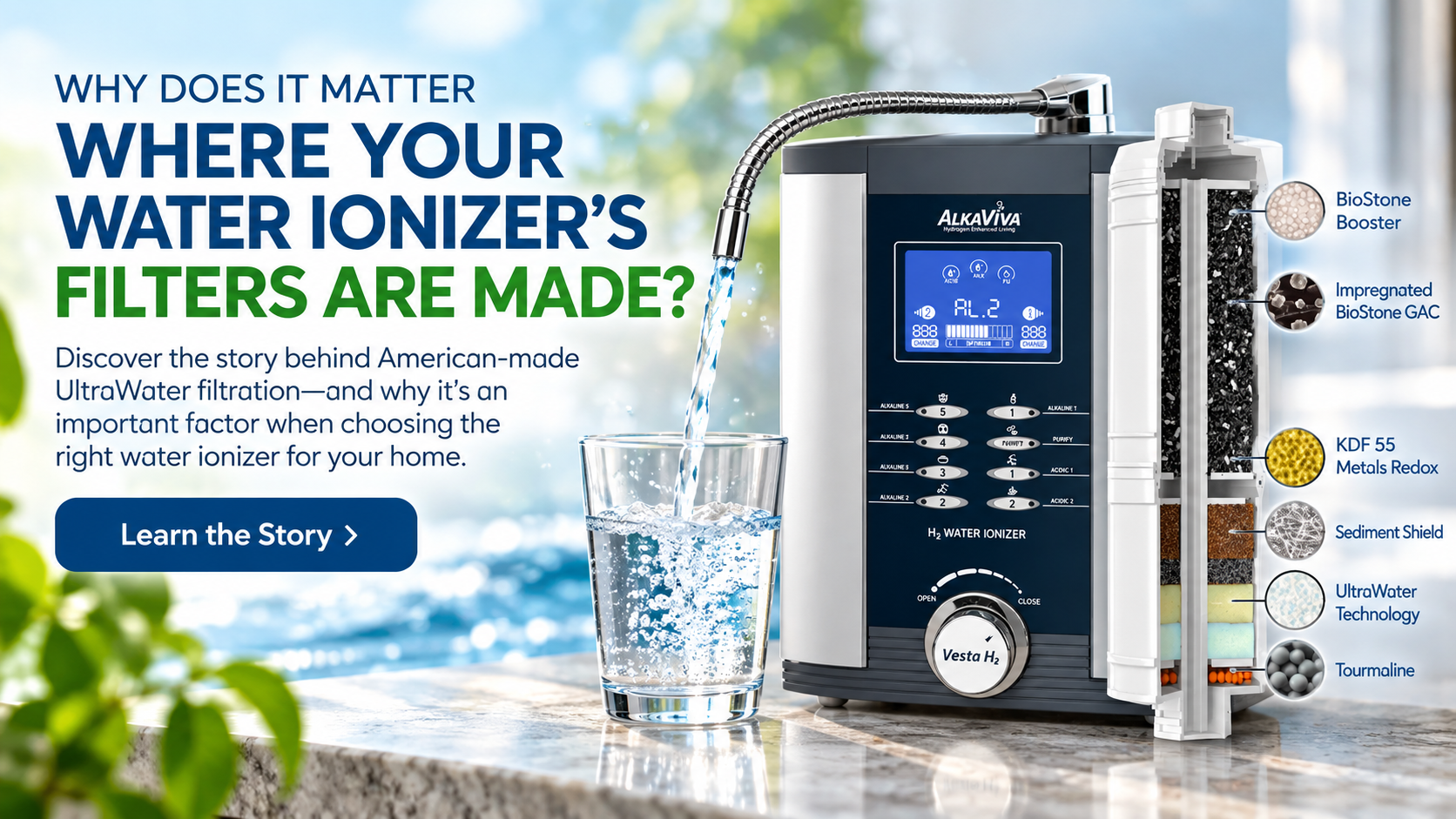
Its UltraWater filtration system incorporates multiple specialized media and treatment stages, including:
- BioStone Booster: Specialized filtration media designed to contribute to chlorine and chloramine reduction.
- Impregnated BioStone GAC: Granular activated carbon combined with additional specialized materials for contaminant reduction.
- KDF 55: A copper-zinc redox medium used in water treatment to address certain metals and chlorine.
- Sediment Shield: A filtration stage designed to capture suspended particles and sediment.
- UltraWater Technology: Proprietary filtration media and disc technology that provide additional contaminant-reduction capabilities.
- Tourmaline: A mineral component incorporated into the filtration system.
Each component has a particular role in the overall filtration design. The effectiveness of the complete system depends on how these materials are selected, combined, and manufactured, as well as the conditions under which the water passes through them.
For water ionizer users, another important consideration is that UltraWater is designed to retain most of the water's naturally occurring dissolved minerals, including calcium and magnesium, which contribute to the conductivity needed for electrolysis.
But an innovative design is only part of the story.
How do we know whether a filtration system actually accomplishes what its manufacturer claims?
That's where independent laboratory testing becomes so important.
UltraWater: Independently Tested Against 249 Drinking Water Contaminants
AlkaViva didn't stop at developing its own filtration technology. The company commissioned independent laboratory testing to document how effectively UltraWater reduces a broad range of drinking water contaminants.
Testing was performed by independent laboratories, including Silver State Analytical Laboratories, using established EPA analytical methods and applicable laboratory accreditation standards.
Silver State Analytical Laboratories is a certified environmental testing laboratory specializing in water and environmental analysis.
The published UltraWater H2 Series test summary includes testing performed between 2012 and 2020 and documents results for 249 drinking water contaminants.
These include heavy metals, pesticides, herbicides, pharmaceuticals, hormones, industrial chemicals, disinfection byproducts, and PFAS.
Importantly, the filtration system was tested without ionization or electrolysis.
The test water passed through the filtration system at a flow rate of 3 liters per minute, replicating the flow rate and contact time of AlkaViva H2 Series water ionizers.
This allowed the laboratories to evaluate the filtration system's contaminant-reduction performance independently of the electrolysis process.
What Did the Laboratory Results Show?
The published results demonstrate substantial reductions across a broad range of contaminants, with the vast majority reduced to the laboratory's non-detectable reporting levels under the reported test conditions.
Here are several examples from the published UltraWater laboratory test summary:
| Contaminant | Before Filtration | After UltraWater |
|---|---|---|
| Lead | 0.061 mg/L | ND |
| Arsenic | 0.043 mg/L | ND |
| Chromium VI | 0.958 mg/L | ND |
| PFOA (PFAS) | 0.21 µg/L | ND |
| PFOS (PFAS) | 0.38 µg/L | ND |
| Glyphosate (Herbicide) | 860 µg/L | ND |
ND means the contaminant was not detected at the laboratory's specified reporting limit. It does not necessarily mean the contaminant was completely absent. Results reflect the tested filtration configuration and laboratory conditions; actual performance may vary with source-water quality, flow rate, filter age, and other operating conditions.
Fluoride reduction was also tested, but that test included the additional Fluoride Shield filter. The fluoride results should therefore be understood as applying to that filtration configuration rather than the standard UltraWater filter alone.
These results provide something much more meaningful than a general statement that a filter removes contaminants: documented measurements of the water before and after filtration.
View the UltraWater Laboratory Test Results »
Why I Chose AlkaViva When I Started Selling Water Ionizers in 2008
When I first started selling water ionizers in 2008, I was drawn to AlkaViva because of its dedication to both water ionizer quality and water filtration.
Over the years, I've researched and compared many different water ionizer brands. I've learned that it's important to look beyond impressive advertising claims and focus on actual performance, engineering, independent testing, and long-term reliability.
AlkaViva's water ionizers have consistently impressed me in these areas.
But what initially drew me to the company, and what continues to distinguish it in my eyes, is its commitment to the quality of the water being filtered before it is ionized.
AlkaViva didn't simply develop an excellent water ionizer and consider the job finished. It recognized that comprehensive filtration deserved the same attention as the machine's ionization technology.
Rather than relying solely on the standard filters supplied by its water ionizer manufacturers, AlkaViva invested in developing its own American-made filtration technology and documenting its performance through independent laboratory testing.
That commitment has always been an important part of why I chose to offer AlkaViva water ionizers through Alkaline Water Plus.
Excellence in Water Ionization AND Water Filtration
Even when consumers focus exclusively on the water ionizer itself, there are important performance and engineering characteristics to consider.
These include electrode construction, hydrogen production, cleaning systems, power management, durability, ease of use, and warranty protection.
In my experience, AlkaViva has consistently demonstrated a strong commitment to these aspects of water ionizer design.
Its H2 Series incorporates advanced electrode technology, automatic cleaning systems, and electronic controls designed to maintain effective operation under varying water conditions.
But the company's commitment doesn't end with the ionizer itself.
AlkaViva incorporates its proprietary UltraWater filtration technology into the water ionizers it sells, bringing together advanced water ionization and comprehensive drinking water filtration.
For me, that's an important distinction.
A water ionizer can be an exceptional machine, but the quality of the water you drink also depends on the effectiveness of its filtration system.
Both deserve careful consideration.
What Should You Look for When Choosing a Water Ionizer?
If you're comparing water ionizers, I encourage you to look beyond the number of electrodes, the appearance of the machine, and the manufacturer's advertising claims.
Ask questions about the filtration system, too.
- Where was the filtration system developed and manufactured?
- Was it designed to address the contaminants found in your particular water supply?
- What filtration materials and technologies does it use?
- Has the complete filtration system undergone independent laboratory testing?
- Which contaminants were tested, and what were the actual results?
- Were the tests performed under conditions representative of normal water ionizer use?
- Does the system preserve the dissolved minerals needed for effective ionization?
- Are specialized filtration options available for fluoride, well water, or other specific concerns?
- What is the expected filter life, and are replacement filters readily available?
These questions can help you determine whether a particular water ionizer's filtration system is appropriate for your home and your water-quality priorities.
And remember, the country in which a filter is manufactured is only one consideration. The design, materials, manufacturing quality, and documented contaminant-reduction performance are what ultimately determine how effectively it filters your water.
American-Made UltraWater: A Commitment That Paid Off
AlkaViva's decision to develop its own American-made UltraWater filtration system was an investment in something that matters enormously: the quality of the water people drink every day.
And that commitment has paid off.
In my experience selling water ionizers since 2008, AlkaViva has remained one of the most popular brands among the customers I've worked with. I believe its commitment to advanced water filtration is an important part of that success.
AlkaViva recognized that developing an exceptional water ionizer was only part of the equation. The company also wanted to provide a filtration system capable of addressing a much broader range of drinking water contaminants than conventional water ionizer filtration typically targets.
That vision led to the development of UltraWater, its American-made filtration technology, and to independent laboratory testing documenting its contaminant-reduction performance.
For consumers who are serious about both water ionization and the quality of their drinking water, I believe that commitment deserves careful consideration.
Because choosing the right water ionizer isn't just about what the machine does to your water. It's also about what the filtration system removes before the water reaches the electrolysis chamber.
Discover AlkaViva Water Ionizers with UltraWater Filtration
Explore AlkaViva's advanced water ionizers and learn more about the American-made UltraWater filtration technology included with them.
Explore AlkaViva Water Ionizers »