Water Ionizer vs Reverse Osmosis: Which Is Better for Everyday Drinking?
Published by Alkaline Water Plus
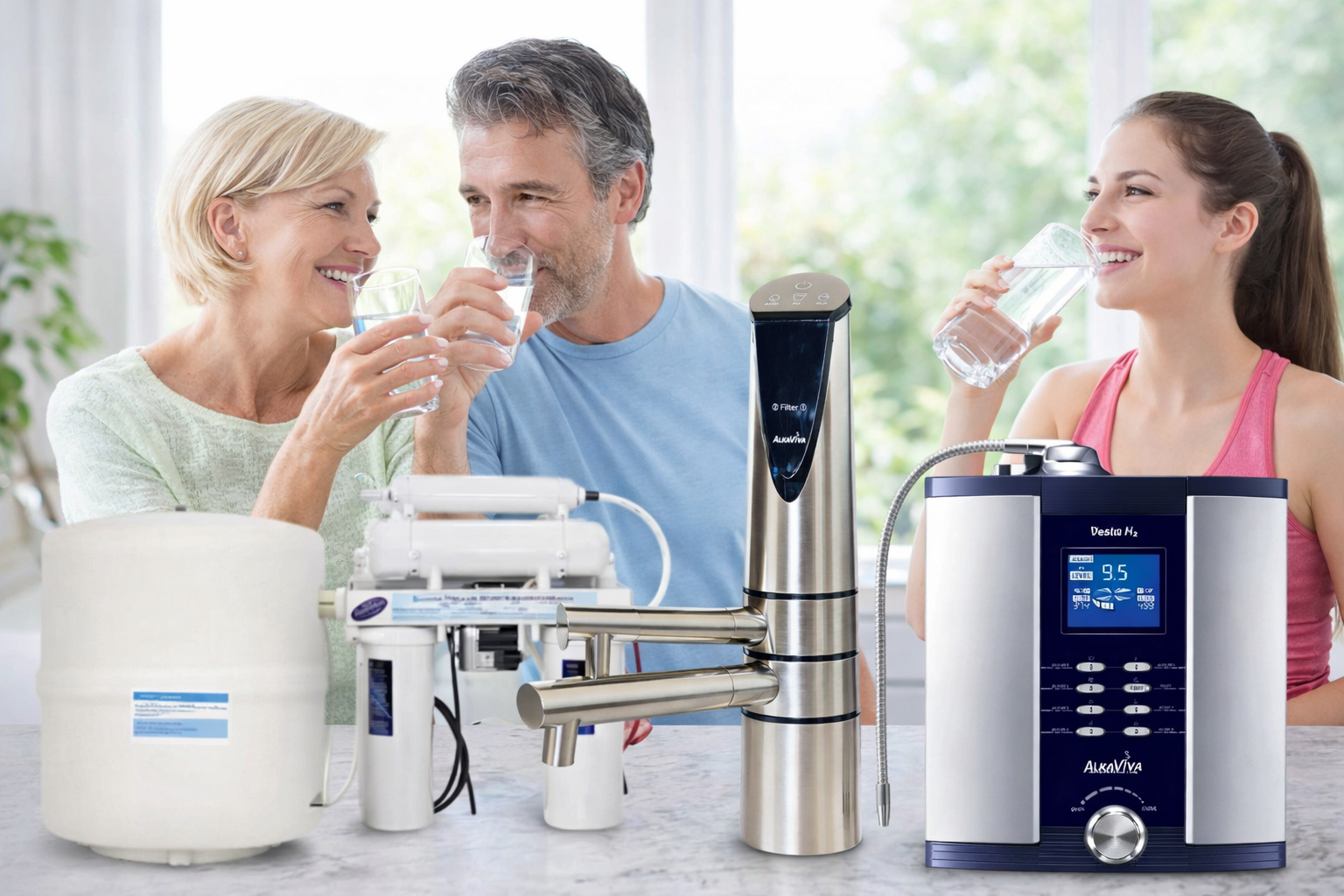
Water Ionizer vs Reverse Osmosis: Which Is Better for Everyday Drinking?
If you’re researching better drinking water, you’ve likely encountered two leading options: reverse osmosis (RO) systems and water ionizers. Both aim to improve water quality — but they do so in fundamentally different ways.
This guide goes beyond surface-level comparisons. We examine filtration, mineral content, molecular hydrogen, hydration research, pH range, long-term use, and real-world practicality, drawing from peer-reviewed studies and published research already documented on AlkalineWaterPlus.
The goal is not to oversimplify — but to help you make an informed, confident decision about what makes sense for everyday drinking.
The Core Difference: Removal vs Optimization
Reverse osmosis systems are designed to remove as much as possible from water. Water ionizers are designed to optimize filtered water — preserving minerals, adjusting pH, and producing molecular hydrogen.
That distinction explains nearly every downstream difference in taste, hydration, environmental impact, and long-term value.
Reverse Osmosis: Strengths and Tradeoffs
Reverse osmosis uses a semi-permeable membrane to reduce a wide range of dissolved substances. Properly designed RO systems can effectively reduce chlorine, heavy metals, fluoride, nitrates, and total dissolved solids (TDS).
Note: There is a new kind of reverse osmosis (tankless) such as the Perfect & Pure Tankless Reverse Osmosis, that has fewer tradeoffs.
Where RO excels
-
- Strong contaminant reduction
- Very low TDS output
- Useful for specific contamination concerns
Important tradeoffs
-
- Removes naturally occurring minerals
- Eliminates dissolved gases, including molecular hydrogen
- Produces wastewater during filtration
- Relies on storage tanks and slower refill rates (except the tankless ones)
Because RO water is essentially stripped, many users add remineralization cartridges or mineral drops to restore taste and balance unless the RO system specifically remineralizes the water sufficiently as a built in feature.
Water Ionizers: Filtration Plus Functional Enhancement
Water ionizers begin with filtration, then use electrolysis to separate water into alkaline and acidic streams. For drinking, most people use the alkaline output, typically in the pH 8.5–9.5 range.
Unlike RO, ionizers work with the minerals already present in filtered water and can produce dissolved molecular hydrogen (H₂), one of the most actively researched aspects of ionized water.
What distinguishes ionized water
-
- Mineral retention
- Adjustable drinking pH
- Molecular hydrogen production
- Instant water (no storage tank)
- Multiple household water uses
What the Research Says About Ionized & Hydrogen Water
The conversation around alkaline and ionized water often swings between exaggerated claims and blanket dismissal. A more accurate picture emerges when examining peer-reviewed research directly.
Drinking pH (8.5–9.5) & Hydration
Research suggests that mildly alkaline water may support hydration efficiency and buffering capacity when consumed as part of daily water intake. This does not imply altering blood pH, which the body regulates tightly — but rather supporting hydration quality and comfort.
A detailed review of hydration, mineral balance, and drinking pH — with links to peer-reviewed studies — is available here:
Benefits of Alkaline Ionized Water
Molecular Hydrogen (H₂)
Molecular hydrogen has been studied for its role as a selective antioxidant, meaning it may neutralize harmful free radicals while preserving beneficial signaling molecules.
Human and animal studies examining hydrogen-rich water are summarized here:
Hydrogen Water & Ionized Water Research
Reverse Osmosis vs UltraWater® Filtration: Which Better Addresses Today’s Water?
UltraWater® filtration takes a more modern, targeted approach—focusing on what is removed, what is preserved, and how well the resulting water supports everyday use.
- The RO Philosophy: Maximum Stripping
- The UltraWater® Approach: Targeted, Tested, Mineral-Preserving
AlkaViva H2 water ionizers utilize UltraWater® filtration, a multi-stage system that has been independently lab tested for the reduction of more than 150 contaminants—including many that are increasingly relevant in today’s water supplies.
Rather than relying on a single membrane, UltraWater uses layered adsorption, catalytic media, and advanced carbon technologies to address a broad spectrum of contaminants while preserving beneficial minerals.
- Independently tested for over 150 contaminants
- Effective reduction of chlorine, chloramines, VOCs, and heavy metals - RO has limited effectiveness against some VOCs without added carbon stages
- Targeted reduction of PFAS (“forever chemicals”) - Not all RO systems are certified for PFAS reduction
- Designed to reduce microplastics and nanoplastics
- Maintains mineral content and water functionality - RO removes minerals that contribute to taste and hydration
Full UltraWater filtration performance data is available here:
UltraWater® Filters: Lab-Tested Performance & Specifications
Modern Contaminants Require Modern Filtration
Many of today’s most concerning contaminants—such as PFAS compounds, microplastics, nanoplastics, and certain VOCs—are not consistently addressed by RO membranes alone. Effectiveness often depends on supplemental carbon stages, contact time, and system design.
UltraWater filtration is engineered specifically for these emerging challenges, offering a filtration strategy aligned with real-world water conditions, not just laboratory purity metrics.
Learn more about filtering modern contaminants:
Removing PFAS from Drinking Water
Microplastics & Nanoplastics: How and Why to Filter Wisely
The Practical Takeaway
For many households, AlkaViva H2 ionizers with UltraWater filtration offer a balanced, research-supported solution: robust contaminant reduction without sacrificing hydration quality.
Suggested Additional Reading: