Why Are Hydrogen Water Bottles Suddenly Everywhere?
Published by Alkaline Water Plus
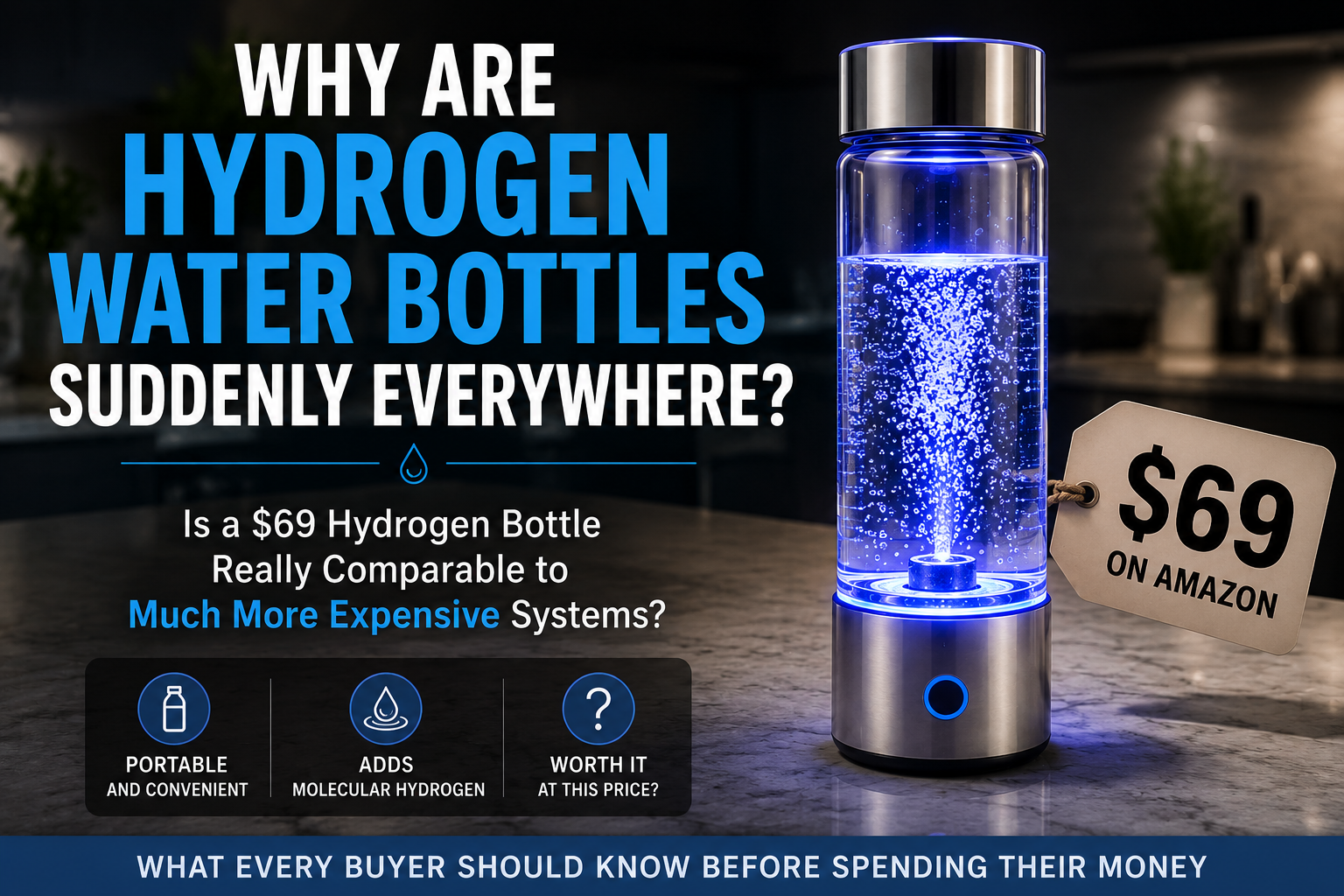
Why Are Hydrogen Water Bottles Suddenly Everywhere?
Why spend several thousand dollars on a water ionizer when Amazon sells hydrogen water bottles for $69?
That is a fair question—and it's one more people are asking as portable hydrogen bottles appear all over Amazon, social media, online advertisements, and wellness videos.
Some of these little bottles look impressive. They glow with colored lights, fill the water with visible bubbles, and make claims about “high-concentration hydrogen,” “medical-grade SPE/PEM technology,” or “therapeutic antioxidant water.” Many are inexpensive enough to buy on impulse.
But are they really the same as a quality hydrogen water machine or water ionizer?
The answer is no—but that does not necessarily mean a portable hydrogen bottle is a bad choice. It means that several very different types of water machines are now being marketed under the broad heading of hydrogen water, and buyers may not realize how differently they work.
Before deciding what to buy, it helps to understand what each type of machine does, what it does not do, and whether the manufacturer or seller will still be there when you need replacement parts, warranty service, or technical support.
Why Have Hydrogen Water Bottles Become So Popular?
Interest in molecular hydrogen has grown substantially as researchers continue studying its antioxidant and cell-signaling effects. At the same time, manufacturing small rechargeable electrolysis devices has become easier and less expensive.
This combination created the perfect online product:
- Small enough to ship inexpensively
- Visually appealing when the bubbles and colored lights appear
- Easy to demonstrate in a short social-media video
- Inexpensive enough for an impulse purchase
- Simple for sellers to private-label under a new brand name
One factory can produce similar-looking bottles for many different online sellers. The name, packaging, claimed hydrogen level, and price may change even when the basic product looks nearly identical.
That does not prove that every inexpensive hydrogen bottle is poorly made. It does mean that the name printed on the box may tell you very little about who manufactured the machine, who tested it, and who will take responsibility for it after the sale.
Why Can Some Online Sellers Offer Hydrogen Bottles So Cheaply?
A low-cost marketplace seller may have few of the expenses carried by an established water-equipment company. The seller may not maintain a repair facility, stock replacement parts, employ trained technical-support personnel, test every unit, or continue carrying the same model for very long.
In some cases, the business behind the listing is primarily a marketing company. Once its supply of a particular bottle is sold, it can move on to a different model or disappear under another brand name.
This is one reason a hydrogen bottle can receive hundreds of positive reviews and still leave its owner without help when the battery, glass container, charging port, gasket, membrane, or electronic base eventually fails.
The bottle may have come with a “one-year warranty,” but that warranty is only useful when:
- You can identify the company responsible for honoring it.
- The seller is still in business.
- Someone responds to your request for assistance.
- Replacement components are available.
- The cost of returning the machine does not approach the cost of replacing it.
At a price of $49 or $69, many of these bottles are treated as disposable products. If one stops working, the customer is expected to throw it away and order another.
That may be acceptable to someone who only wants to experiment with hydrogen water. It is less appealing to someone who expects to use the machine every day.
Visible Bubbles Do Not Tell the Whole Story
People understandably associate a large number of bubbles with a large amount of molecular hydrogen. However, bubbles alone do not prove the final concentration of dissolved hydrogen in the water.
Some gas may escape into the space above the water. Bubble size, water temperature, pressure, cycle length, mineral content, container design, membrane condition, and the quality of the electrodes can all affect the result.
A bottle can therefore look extremely active without necessarily delivering everything its advertising promises.
Another concern is what happens to the gases produced during electrolysis. A properly designed SPE/PEM system separates the hydrogen intended for the drinking water from oxygen and other possible electrolysis by-products. The quality of the membrane, electrode coatings, seals, venting system, and overall construction matters.
This is why I recommend looking beyond the colored lights and asking who made the internal components, how the device handles unwanted gases, whether its performance has been tested, and how the machine will be serviced later.
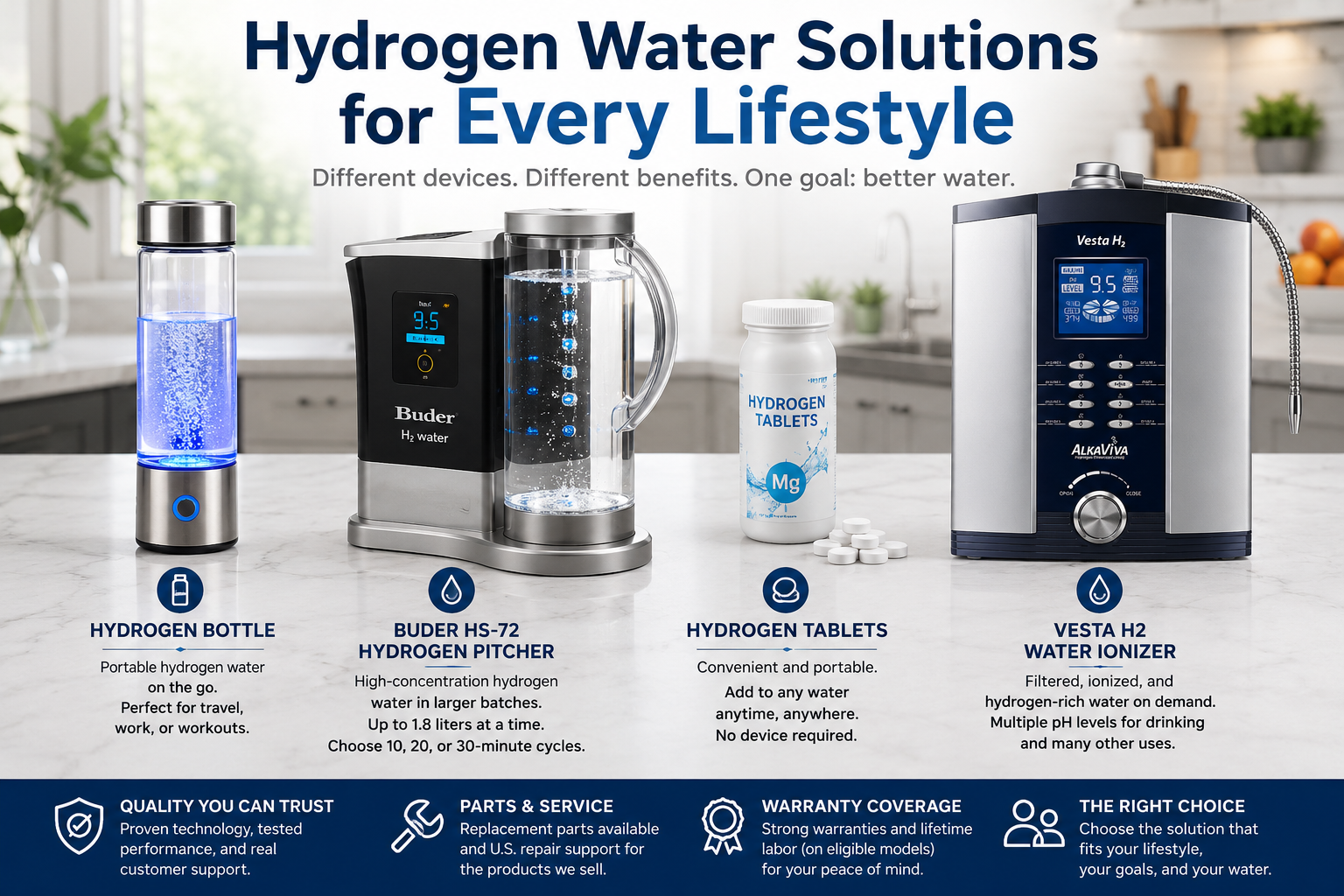
Not All Hydrogen Water Systems Are the Same
Today’s buyer may encounter several different products that all seem to promise some version of hydrogen-rich water. The major categories include:
- Portable hydrogen water bottles
- Countertop hydrogen water generators
- Hydrogen tablets
- Countertop water ionizers
- Under-sink water ionizers
They are not interchangeable. Each has a different purpose.
| Type | Primary Purpose | Water Volume | Filters Water? | Changes pH? | Best Use |
|---|---|---|---|---|---|
| Portable hydrogen bottle | Adds dissolved molecular hydrogen | Usually one small serving | Usually not traditional contaminant filtration | Usually very little | Travel, office, gym, individual use |
| Countertop hydrogen generator | Produces larger batches of hydrogen-rich water | Pitcher-sized batches | Requires appropriately filtered source water | Generally no meaningful change | High-hydrogen water at home |
| Hydrogen tablets | Release hydrogen through a chemical reaction | One glass or bottle | No | May affect mineral content or taste | Occasional use without buying a machine |
| Countertop water ionizer | Filters and electrolyzes water continuously | Fresh water on demand | Yes, depending on its filtration system | Yes, adjustable | Daily household drinking and multiple water uses |
| Under-sink water ionizer | Filters and ionizes water through a dedicated faucet | Fresh water on demand | Yes, depending on its filtration system | Yes, adjustable | Permanent installation with a clear countertop |
Option 1: Portable Hydrogen Water Bottles
A portable hydrogen water bottle is designed to treat a relatively small amount of water at one time. Depending on the model, you fill the bottle or glass, press a button, and allow the machine to run for several minutes.
The main advantage is portability. A good bottle can be useful:
- At work
- While traveling
- At the gym
- In a hotel
- For someone who wants to try hydrogen water before investing in a larger system
The main limitations are capacity and source-water quality. A hydrogen bottle generally does not replace a comprehensive drinking-water filter. Unless the manufacturer clearly states otherwise and provides meaningful test information, assume that the water should be properly filtered before it goes into the bottle.
A small bottle also produces only one serving at a time. Making enough water for several people throughout the day may involve repeated filling, cycling, charging, and cleaning.
What Makes the High-Rich HR4 Different From a Typical Low-Cost Bottle?
I sell the High-Rich HR4 Portable Hydrogen Water Machine because it addresses several weaknesses commonly found in disposable marketplace bottles.
The HR4 uses a DuPont SPE/PEM membrane with platinum-coated titanium electrodes. Its electrolysis design is intended to pump molecular hydrogen into the drinking water while separating chlorine, ozone, and other oxidation by-products from it.
It holds approximately 9.5 ounces and offers five-minute and seven-minute operating cycles. It can be used with suitable tap water, filtered water, reverse-osmosis water, or distilled water, although very hard water may cause scale and require more frequent maintenance.
Most importantly, it is not sold as a throwaway mystery product. Support is available after the sale, and replacement components—including batteries, glass cups, and other parts—are available. The HR4 has an authorized U.S. repair depot, a one-year parts warranty, and a limited lifetime labor warranty.
The rechargeable battery will eventually wear out, as rechargeable batteries do. The difference is that an HR4 owner can obtain another one rather than automatically discarding the entire machine.
I have personally tested many small hydrogen devices. The HR4 is the portable model I chose to carry because it combines good hydrogen production, a quality membrane, portability, replacement-part availability, and actual service support.
A Portable Bottle Can Be Excellent—When It Is the Right Bottle
A good portable hydrogen bottle may be exactly what a traveler, office worker, athlete, or single user needs. The mistake is assuming that every glowing bottle shown online is essentially the same.
Before buying one, ask:
- Does it use a genuine SPE/PEM membrane?
- What materials are used for the electrodes?
- How are oxygen, ozone, and chlorine gases separated or vented?
- What water is safe to put into it?
- Can the battery be replaced?
- Can the glass or bottle be replaced?
- Who repairs it?
- Is there a real warranty facility in the United States?
- Will parts still be available after the online listing disappears?
Option 2: Countertop Hydrogen Water Generators
A larger countertop hydrogen generator is designed for someone who wants more than one small glass at a time but does not necessarily want alkaline water or multiple pH settings.
This type of appliance focuses primarily on producing molecular-hydrogen-rich water. It generally does not significantly raise the drinking water’s pH.
The Buder HS-72: My Countertop Hydrogen Choice
The Buder HS-72 Hydrogen Water Machine is a premium countertop hydrogen generator that makes as much as 1.8 liters at a time.
Its hydrogen-generating chamber is separate from the pitcher that holds the drinking water. Distilled or deionized water is placed in the generating chamber, while filtered drinking water is placed in the pitcher. The machine then transfers hydrogen into the drinking water rather than electrolyzing the drinking water directly between exposed plates.
The Buder uses a DuPont SPE/PEM membrane and provides 10-, 20-, and 30-minute cycles. Its dual-chamber construction keeps the upper and lower electrodes separated, and unwanted oxygen, ozone, or chlorine gases are released outside the drinking-water pitcher.
Unlike a small portable bottle, the Buder is intended to remain on a stable countertop. Its larger pitcher allows me to prepare enough hydrogen-rich water to drink over a longer part of the day.
The Buder HS-72 includes a one-year parts warranty and a five-year labor warranty. Replacement pitchers, filters, and other support items are also available.
What I Personally Drink When I Can Choose Anything
After approximately 30 years of drinking ionized water and many years of testing hydrogen-producing products, people sometimes ask what I personally drink.
When I am at home and can choose anything I want, most of my daily drinking water comes from two machines:
I do not see them as competing products because I use them for different reasons.
Why I Use the Vesta H2 Water Ionizer
The Vesta H2 is my primary everyday water system because it does several jobs in one machine. It filters my incoming water, produces fresh ionized and hydrogen-rich water on demand, and gives me a selection of pH levels for different household uses.
There is no batch to prepare and no small bottle to refill repeatedly. I turn on the faucet connection and make the amount I need.
That makes a quality water ionizer especially practical for:
- Daily hydration
- More than one household member
- Filling larger drinking containers
- Cooking and food preparation
- Producing lower-pH water for appropriate non-drinking uses
- Reducing contaminants through a substantial filtration system
A portable bottle may add hydrogen to a small serving of water, but it does not offer the Vesta H2’s combination of continuous filtration, adjustable ionization, multiple water settings, and family-sized production.
Why I Also Use the Buder HS-72
At other times, I want a prepared pitcher of water that is exceptionally rich in dissolved molecular hydrogen without substantially changing its pH. That is when I use the Buder HS-72.
The Buder is a specialized hydrogen machine. I begin with filtered drinking water, prepare a large pitcher, and drink it alongside the ionized water from my Vesta H2.
Therefore, my personal choice is not one machine instead of the other. It is a quality water ionizer for my principal drinking-water system and a dedicated countertop hydrogen generator for additional high-hydrogen water.
I use the HR4 when portability is important. In simple terms:
- Vesta H2: my main source of filtered, freshly ionized, hydrogen-rich water.
- Buder HS-72: my larger-batch source of high-concentration hydrogen water without a significant pH change.
- High-Rich HR4: a portable source of hydrogen water for travel or individual servings.
Option 3: Hydrogen Tablets
Hydrogen tablets use a chemical reaction—commonly involving magnesium—to release molecular hydrogen when the tablet is dropped into water.
They can be convenient because there is no machine to charge, clean, or maintain. They may be useful during travel or for someone who only wants hydrogen water occasionally.
However, tablets are consumable. Every glass requires another tablet, so the ongoing expense can become significant for someone drinking hydrogen water every day.
Tablets also add reaction products and minerals to the water. Some people do not mind this, while others prefer hydrogen water produced by a machine without adding a tablet to every serving.
Hydrogen tablets do not filter the original water. The quality of the water you begin with remains important.
Option 4: Countertop Water Ionizers
A countertop water ionizer is connected to the water supply, usually through a faucet diverter or direct-plumb connection. It filters the water and then passes it through an electrolysis chamber.
A quality ionizer can provide:
- Filtered water
- Dissolved molecular hydrogen
- Adjustable alkaline drinking-water settings
- Lower-pH water for selected external and household uses
- Fresh water continuously rather than one small batch at a time
This explains much of the price difference between a $69 bottle and a premium ionizer. You are not merely buying a larger hydrogen bottle. You are buying a plumbed drinking-water appliance with filtration, electronic controls, an electrolysis chamber, multiple electrodes, cleaning systems, flow controls, replaceable filters, warranty coverage, parts support, and the capacity to serve a household for many years.
That does not mean every expensive water ionizer is worth its price. Plate quality, cleaning design, filtration, warranty terms, company history, testing, repair service, and performance in the buyer’s actual water all matter.
Option 5: Under-Sink Water Ionizers
An under-sink ionizer performs the same basic jobs as a countertop ionizer but keeps the main machine below the counter. The water is controlled through a dedicated faucet mounted at the sink.
This arrangement is ideal for someone who wants:
- A clean and uncluttered countertop
- A permanent installation
- Filtered and ionized water directly from a dedicated faucet
- A system suitable for everyday household use
Under-sink systems generally cost more to install and are not portable. Their value is convenience, appearance, filtration, and continuous access to freshly produced water.
Which Hydrogen Water Option Is Right for You?
Choose a portable hydrogen bottle when:
- You travel frequently.
- You primarily need individual servings.
- You already have a dependable source of filtered water.
- You want a lower-cost introduction to hydrogen water.
- You are willing to fill, operate, and recharge a small device repeatedly.
Choose a countertop hydrogen generator when:
- Your main interest is high-concentration molecular hydrogen.
- You do not need multiple alkaline and acidic pH settings.
- You want to prepare a larger pitcher instead of one small bottle.
- You already have properly filtered drinking water.
Choose hydrogen tablets when:
- You want occasional hydrogen water without buying a machine.
- You need something extremely easy to pack.
- You do not mind the ongoing cost or the minerals introduced by the reaction.
Choose a countertop water ionizer when:
- You want a primary drinking-water system.
- You need meaningful filtration as well as molecular hydrogen.
- More than one person will use the machine.
- You want fresh water on demand throughout the day.
- You value adjustable pH levels and multiple household uses.
Choose an under-sink water ionizer when:
- You want the benefits of a full ionizer without using countertop space.
- You prefer a dedicated faucet.
- You are comfortable with permanent plumbing installation.
Can a $69 Hydrogen Bottle Replace a $3,000 Water Ionizer?
For most households, no. They perform different jobs.
A small hydrogen bottle may produce a glass of hydrogen-rich water. A water ionizer is intended to become the household’s primary source of filtered, freshly produced drinking water.
It would be more accurate to compare a portable hydrogen bottle to a travel appliance and a quality water ionizer to a long-term kitchen appliance.
The inexpensive bottle may still be the better choice for a particular person. Someone who travels constantly, lives alone, already owns an excellent filtration system, or only wants occasional hydrogen water may not need a full ionizer.
On the other hand, repeatedly operating a small bottle may quickly become inconvenient for a family that drinks several quarts of water each day.
Beware of Specifications That Sound Better Than They Are
Hydrogen-water listings often compete by claiming increasingly high concentrations. One seller advertises 3 ppm, another claims 5 ppm, and another suddenly promises 8 or 10 ppm from a nearly identical-looking device.
Do not rely on the largest number in the product title.
Ask how the result was measured, what water was used, when the measurement was taken, whether the container was pressurized, and whether the result represents dissolved hydrogen in the water or a calculated amount of gas produced by the machine.
Also watch for phrases such as:
- “FDA approved” when the claim may only concern food-contact materials
- “Medical grade” without identifying a recognized medical-device standard
- “Japanese technology” without naming a Japanese manufacturer
- “DuPont technology” without confirming the actual membrane source
- “Lifetime warranty” without explaining who pays for parts, labor, and shipping
- “Filters harmful contaminants” without a replaceable filter or complete test report
A long list of certifications or logos is not meaningful unless the seller explains exactly what was certified and whether it applies to the complete machine or only to certain materials or electrical components.
The Questions That Matter More Than the Sale Price
Before buying any hydrogen water product, I recommend asking:
- What exactly does this product do? Does it only add hydrogen, or does it also filter and ionize the water?
- What water must I put into it? Tap, filtered, reverse-osmosis, distilled, soft, or mineral water?
- What is the actual daily capacity? One glass, one pitcher, or continuous production?
- What parts will wear out? Battery, membrane, electrodes, seals, glass, pitcher, filter, or pump?
- Can those parts be replaced?
- Where is the repair facility?
- Who pays labor, parts, and shipping under the warranty?
- Has the seller personally tested the machine?
- How long has the seller carried and supported this model?
- Will someone help me use and maintain it properly?
My Final Thoughts After Decades of Testing Water Machines
I am pleased that portable hydrogen bottles have introduced more people to molecular hydrogen. Some are useful and well designed, and portability is a genuine advantage.
However, the flood of inexpensive bottles has also made it difficult to distinguish durable equipment from short-lived private-label gadgets. The outside of a machine does not reveal the quality of its membrane, electrodes, electronics, seals, testing, warranty, or service network.
A cheap bottle may be all someone needs. A quality portable machine such as the HR4 may be a better choice for someone who wants portability with replacement parts and repair support. A countertop hydrogen generator such as the Buder HS-72 may be appropriate for someone who wants larger quantities of high-hydrogen water without significantly changing the pH.
For my own principal source of daily drinking water, I continue to choose the Vesta H2 because it combines advanced filtration, molecular hydrogen, adjustable pH levels, and continuous production for everyday use.
When I want an additional pitcher of especially hydrogen-rich water, I use my Buder HS-72. When portability matters, the HR4 fills that need.
The best system is not automatically the cheapest or the most expensive. It is the one that produces the kind and quantity of water you need—and is backed by people who will still help you after the sale.
Need Help Choosing?
Every home, water supply, and household is different. Before recommending a machine, I consider your local water quality, household size, installation preferences, desired hydrogen level, filtration needs, and budget.
This article is intended for general educational purposes. Hydrogen water and alkaline ionized water are not substitutes for medical diagnosis or treatment. People with kidney disease, fluid restrictions, electrolyte restrictions, or other medical concerns should consult an appropriate healthcare professional about their individual drinking-water needs.