

Water Filtration Is Easier Than You Think
You don't have to become a water chemist to choose a good water filter. The most important thing is to understand the water you're starting with, identify what you want to remove or correct, and then match the right filtration technology to the job.
This page will help you understand:
- What's actually in your water
- Which substances are contaminants and which are useful minerals
- How common water-filter media work
- Which filtration technologies are best suited to different water concerns
- When mineral-retaining filtration makes sense
- When reverse osmosis may be the better choice
- How hard water, softened water and source-water chemistry affect filtration and water ionizers
- How to install and maintain drinking-water filter systems
The basic principle is simple: Start with the water you actually have.
Start With Your Source Water
One of the biggest mistakes people make when choosing a water filter is starting with the filter instead of the water.
A filter is a tool. Different tools solve different problems.
Your source water may contain:
- Disinfectants such as chlorine or chloramine
- Disinfection byproducts
- Heavy metals
- Fluoride
- Nitrate or nitrite
- PFAS and other industrial chemicals
- Pesticides, herbicides and VOCs
- Sediment
- Microorganisms
- Hardness minerals such as calcium and magnesium
- Sodium from a whole-house water softener
- Other dissolved salts and minerals
Some of these substances are contaminants. Some are useful minerals. Others aren't necessarily harmful but can affect the way a water-treatment system or water ionizer performs.
Step 1: Find Out What's in Your Water
If you use municipal water, start with your local Consumer Confidence Report or Water Quality Report. Your water utility publishes this information regularly.
You can usually find it by searching your ZIP code along with the words water quality report.
If you use well water, laboratory testing becomes even more important because well-water chemistry can vary considerably from one location to another.
Step 2: Look Beyond Contaminants
For drinking water and especially for water-ionizer use, I also want to know about:
- Water hardness
- Total dissolved solids
- Whether a whole-house water softener is being used
- Sodium or other dissolved salts
- Iron or sulfur problems
- Any unusual taste, odor or staining
Good water treatment is not simply about removing the largest possible number of substances. It is about producing the right finished-water chemistry for the intended use.
Contaminants vs. Useful Minerals
Not everything dissolved in water is something we want to remove.
Calcium and magnesium, for example, are naturally occurring minerals found in many water supplies. They contribute to hardness, but they also contribute mineral content and electrical conductivity.
This becomes particularly important when the water will be used with a water ionizer because electrolysis requires dissolved ions to conduct electrical current.
When Minerals Become Too Much of a Good Thing
Moderate mineral content can be useful. Excessive mineral content can create problems.
Very hard water can contribute to scale inside plumbing, appliances and water ionizers. Around the cathode of a water ionizer, electrolysis creates highly alkaline local conditions that can encourage calcium carbonate and other mineral deposits to form.
At the opposite extreme, highly purified water with very little dissolved mineral content may have poor conductivity and may not ionize effectively.
The goal isn't maximum minerals or minimum minerals. The goal is an appropriate mineral balance for the water's intended use.
Best Water Treatment by Concern
There is rarely one filter medium that does everything equally well. The most effective systems usually combine different technologies, with each one doing a particular job.
| Water Concern | Useful Treatment Choices | Important Note |
|---|---|---|
| Chlorine | Activated carbon, catalytic carbon, tested multi-media filtration | Carbon is especially effective for chlorine when adequate contact time is provided. |
| Chloramine | Catalytic carbon, tested multi-media filtration | Chloramine is more difficult to reduce than free chlorine. |
| Fluoride | Fluoride-specific media, tested UltraWater configurations, reverse osmosis | Look for finished-system testing rather than assuming every filter of a certain type performs the same. |
| Lead & Heavy Metals | Tested multi-media filtration, appropriate specialty media, reverse osmosis | Different metals can require different treatment mechanisms. |
| PFAS | Tested carbon/multi-media systems, reverse osmosis | Actual PFAS testing is particularly valuable when evaluating a system. |
| Nitrate & Nitrite | Reverse osmosis or other nitrate-specific treatment | Standard activated carbon is not usually the primary treatment for nitrate. |
| VOCs, Pesticides & Herbicides | Activated carbon, catalytic carbon, tested multi-media filtration | Performance varies by chemical and filter design. |
| Sediment | Sediment filtration, appropriate mechanical filtration | Removing sediment first can help protect more expensive downstream filters. |
| Microorganisms | Appropriately rated membrane or ceramic filtration, UV or other microbiological treatment | Well-water treatment should be selected according to actual water testing and system ratings. |
| Hard Water | Scale-control treatment, softening, reverse osmosis where appropriate | Hardness is not a contaminant, but excessive hardness can create scale. |
| Sodium From a Water Softener | Reverse osmosis | RO can substantially reduce sodium added by ion-exchange softening. |
| Sulfur / Hydrogen Sulfide | KDF 85 and other sulfur-specific treatment | The best treatment depends on the form and concentration of sulfur present. |
This is why I prefer to think in terms of treatment systems rather than one "magic" filter.
How Common Water Filter Media Work
Water filters don't all remove contaminants in the same way. Some physically block particles. Some attract chemicals to enormous microscopic surfaces. Some exchange ions. Others change contaminants chemically so they can be captured or separated.
Activated Carbon
Activated carbon contains an enormous internal surface area. Many organic chemicals and other substances are attracted to and held on those surfaces through a process called adsorption.
Activated carbon is widely used for:
- Chlorine
- Taste and odor
- Many VOCs
- Many pesticides and organic chemicals
- Numerous other compounds, depending on the carbon and system design
Contact time matters. Water that moves too quickly through a carbon filter may not have as much opportunity to interact with the media.
Carbon Block
Carbon-block filters compress carbon into a solid structure. This can help reduce channeling and can provide both adsorption and mechanical filtration.
The density, pore structure, formulation and flow rate of the block all influence performance.
Granular Activated Carbon (GAC)
Granular activated carbon consists of loose carbon granules. It provides a large adsorptive surface area and is commonly used for chlorine, taste, odor and many organic compounds.
Because it is loose media, system design is important to prevent water from finding pathways that reduce contact with the carbon.
Catalytic Carbon
Catalytic carbon is specially processed to improve its ability to catalyze certain chemical reactions. One of its important applications is chloramine reduction.
It can also be useful for many of the contaminants normally treated with activated carbon.
KDF Media
KDF is a copper-zinc alloy filtration medium that uses oxidation-reduction chemistry. Different KDF formulations are designed for somewhat different water-treatment problems.
KDF media can be useful in systems designed to address substances such as:
- Chlorine
- Certain heavy metals
- Iron
- Hydrogen sulfide
KDF is often combined with carbon or other filtration media because the technologies complement one another.
Activated Alumina and Other Specialty Adsorption Media
Activated alumina is a porous adsorption medium commonly used for contaminants such as fluoride and arsenic under appropriate water conditions.
Its effectiveness depends on factors such as water chemistry, pH, flow rate, contaminant concentration and contact time.
Activated alumina is one useful technology among several. Reverse osmosis and other specialty filtration technologies can also reduce fluoride and arsenic.
Ceramic and Mechanical Filtration
Ceramic and other fine mechanical filters physically prevent particles larger than their effective pore structure from passing through.
They can be particularly useful for sediment and certain microorganisms when the filter is specifically rated for that purpose.
Mechanical pore size alone should not be used to assume removal of every microorganism. The actual finished-filter rating and testing matter.
Sediment Filters
Sediment is one of the easiest and least expensive things to remove from water.
If source water contains substantial sediment, placing a sediment filter before more expensive filtration media can help prevent premature clogging and extend the life of downstream filters.
UltraWater Multi-Media Filtration
UltraWater takes a multi-media approach. Rather than relying on one filtration mechanism, it combines different materials designed to address different groups of contaminants.
This is an important concept in advanced filtration:
Each filtration material has a specific job. No single medium is ideal for everything.
UltraWater finished-system testing has included 249 contaminants, with the vast majority reduced to non-detectable levels under the tested conditions.
For detailed laboratory results, filter construction and a comparison with tankless reverse osmosis, see our UltraWater Filtration page.
Mineral-Retaining Filtration vs. Reverse Osmosis
One of the most important choices in water treatment is whether to selectively filter the water while retaining most of its natural dissolved minerals or to use reverse osmosis to broadly reduce dissolved substances.
Mineral-Retaining Filtration
If your source water has a desirable mineral balance, high-quality multi-media filtration can remove many unwanted contaminants while retaining naturally occurring calcium, magnesium and other dissolved ions.
This can be especially useful when the water will be supplied directly to a water ionizer.
Reverse Osmosis
Reverse osmosis takes a different approach. It uses a highly selective membrane to broadly reduce dissolved substances, including both contaminants and naturally occurring minerals.
That can be particularly useful when dealing with:
- Extremely hard water
- Water from a whole-house sodium-based softener
- High dissolved salts
- Nitrate
- Other source-water conditions where broad dissolved-solids reduction is desirable
Whether or not RO water will be used with a water ionizer, proper remineralization is an important part of the system.
When RO water will feed a water ionizer, remineralization also restores the dissolved ions and conductivity needed for effective electrolysis.
Neither approach is automatically better for every water supply. The source water should help determine the treatment.
For a full explanation, see:
Special Source-Water Problems
Sometimes the issue isn't simply a contaminant. The overall chemistry of the source water can affect the filtration system, plumbing, appliances and water ionizer.
Very Hard Water
Hard water contains elevated calcium and magnesium. These minerals are not contaminants, but excessive hardness can contribute to scale.
This is especially important for water ionizers because electrolysis creates highly alkaline conditions around the cathode that can encourage mineral precipitation.
Learn more: Hard Water and Water Ionizers.
Whole-House Water Softeners
A conventional ion-exchange softener removes calcium and magnesium primarily by exchanging them for sodium.
This solves the hardness problem for plumbing and appliances, but it creates a very different source-water chemistry for drinking and electrolysis.
For very hard water that requires a whole-house softener, one effective arrangement can be:
Hard Water → Softener → Reverse Osmosis → Remineralization → Water Ionizer
Learn more:
Well Water
Well water deserves special attention because its chemistry is not controlled by a municipal treatment system and can vary greatly from one property to another.
Potential concerns can include:
- Iron
- Sulfur
- Manganese
- Hardness
- Sediment
- Microorganisms
- Nitrate
- Arsenic or other naturally occurring substances
Testing should come before choosing a treatment system.
Learn more: Well Water Testing.
Source Water and Water Ionizers
A water ionizer does not operate independently from the water supplied to it.
The minerals, salts and charged substances dissolved in source water influence conductivity, electrolysis, ion migration, scale formation and the chemistry of the finished alkaline and acidic streams.
For a much deeper explanation, read The Chemistry of Water Coming In and Out of a Water Ionizer.
The ionizer changes the water, but the water also affects the ionizer.
Installing & Maintaining Drinking-Water Filters
Most point-of-use drinking-water filter systems are fairly straightforward.
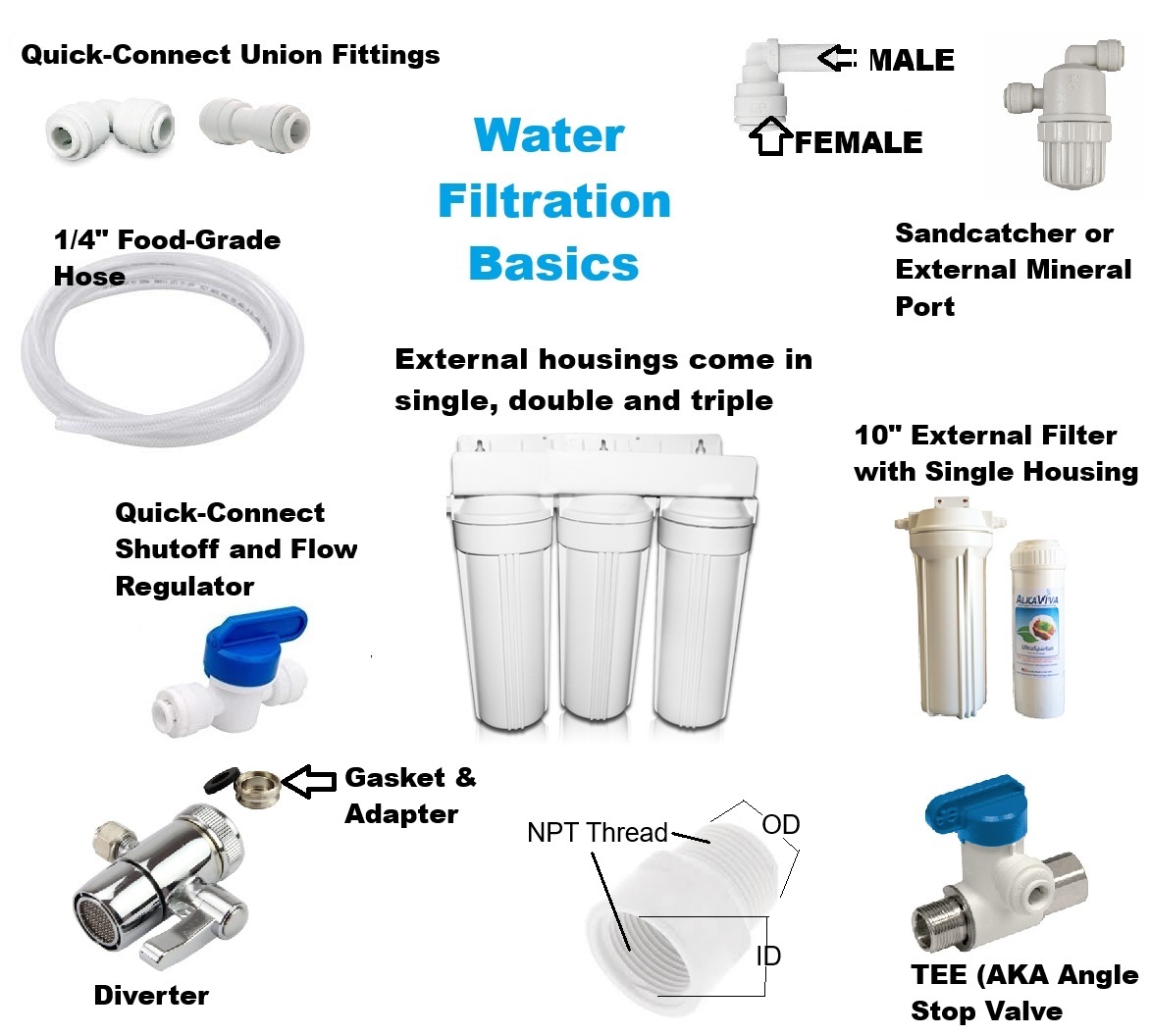
A typical system includes:
- A filter housing or cartridge system
- Food-grade tubing
- A connection to the cold-water supply
- A dedicated faucet, water ionizer or other dispensing point
Water may be supplied through a faucet diverter or through a Tee-connection installed on the cold-water line beneath the sink.
Filter Maintenance Basics
- Replace filters on schedule. Capacity depends on the filter, water quality and actual usage.
- Don't judge filter life by taste alone. Some contaminants have no taste or odor.
- Pay attention to flow rate. A noticeable decrease in flow can indicate clogging, sediment accumulation or scale.
- Flush new filters as directed. Carbon dust and manufacturing residues should be flushed according to the manufacturer's instructions.
- Maintain housings and connections. Check O-rings, fittings, tubing and housings when filters are changed.
- Remember that source water affects filter life. High sediment, hardness or contaminant loading can shorten service life.
Water Filter Installation Demonstrations
Installation Help
Where to Go Next
Once you understand the basics, these pages will help you go deeper into the water-treatment issue that applies to you.
- UltraWater Filtration — Learn how multi-media mineral-retaining filtration works, see independent testing and compare UltraWater with tankless reverse osmosis.
- Reverse Osmosis Water Filtration — Learn how RO works, what it reduces, when we recommend it and why remineralization matters.
- The Chemistry of Water Coming In and Out of a Water Ionizer — Learn how minerals, sodium, hardness, conductivity, filtration and electrolysis all interact.
- Hard Water — Learn how excessive hardness can affect water ionizers and what you can do about it.
- Sodium and Water Softeners — Learn how ion-exchange softening changes the chemistry of drinking water.
- Well Water Testing — Start here if your home uses a private well.
- Water Filters — Browse our water filtration products.
If you're unsure what your water needs, contact us. We are happy to help you look at your source-water conditions and determine which filtration approach makes the most sense.
Alkaline Water Plus: 888-692-5525
Frequently Asked Questions About Water Filtration
How do I know what contaminants are in my tap water?
Start with your municipal Consumer Confidence Report or Water Quality Report. It will show regulated contaminants measured by your water supplier. If you need information beyond what is included in the report, independent laboratory testing can provide a more detailed picture. You can contact me any time for help with this. See the little speech icon at the bottom right or visit our Contact Us page.
What's the best type of water filter?
There isn't one best filter for every water supply. The best treatment depends on your source water, contaminants of concern, hardness, dissolved salts and what you want the finished water to accomplish.
Should I keep minerals in my drinking water?
When source-water conditions allow it, I generally prefer filtration that removes unwanted contaminants while retaining a desirable natural mineral balance. Calcium and magnesium also contribute electrical conductivity when the water will be used with a water ionizer.
When is reverse osmosis a good choice?
RO can be particularly useful for very hard water, sodium-softened water, excessive dissolved salts, nitrate and other conditions where broad dissolved-solids reduction is desirable. Read our Reverse Osmosis Water Filtration page for a complete explanation.
Does reverse osmosis remove fluoride?
Yes. Properly functioning reverse osmosis membranes can substantially reduce fluoride. Fluoride reduction is not simply a matter of whether the fluoride ion is physically smaller than a membrane pore; RO separation involves membrane chemistry, charge and other molecular interactions.
Do carbon filters remove everything?
No. Activated carbon is excellent for many organic chemicals, chlorine, taste and odor, but it is not the ideal treatment for every dissolved contaminant. This is why advanced systems often combine carbon with other filtration technologies.
Do water ionizers also filter the water?
Most electric water ionizers include filtration before electrolysis. The quality and design of that filtration varies considerably by model. Filtration is especially important because undesirable substances should be removed as effectively as possible before the water reaches the electrolysis chamber.
Does a water ionizer remove fluoride?
Fluoride exists primarily as a negatively charged ion in normal drinking water and therefore tends to migrate toward the anode and acidic-water stream during electrolysis. This can provide additional separation, but I still prefer to address fluoride primarily with effective filtration before electrolysis when fluoride reduction is a priority.
How often should water filters be replaced?
There is no single replacement interval for every filter. Filter life depends on the filter's rated capacity, water quality, contaminant loading and how much water you use. Follow the manufacturer's capacity or replacement guidance and shorten the interval when unusually challenging source water requires it.
What is pre-filtration for a water ionizer?
Pre-filtration means treating a particular source-water problem before the water reaches the water ionizer. Examples include excessive hardness, sulfur, sodium-softened water, sediment or unusually difficult contaminants.
Resources
Good water treatment begins with understanding the water you actually have.