Microplastics, Nanoplastics, PFAS, and Modern Water Filtration: What Actually Matters?
Published by Alkaline Water Plus
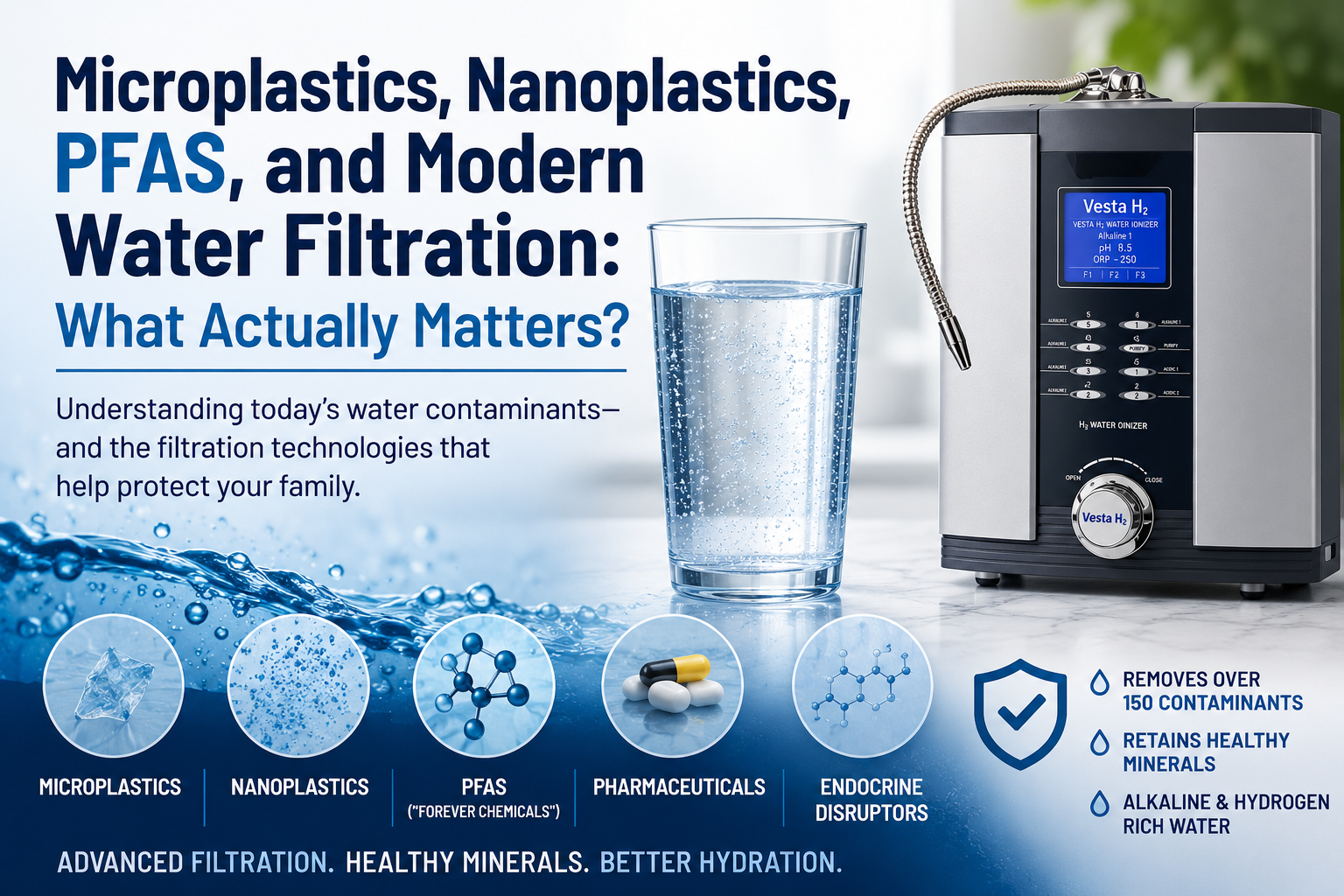
Microplastics, PFAS & Modern Water Filtration | Alkaline Water Plus
Clean drinking water is no longer just about taste, odor, or whether water looks clear. Today, many families are asking deeper questions: What is actually in our water? Can modern filters reduce microplastics, nanoplastics, PFAS “forever chemicals,” pharmaceuticals, endocrine disruptors, and other contaminants? And how does a modern water ionizer fit into the picture?
At Alkaline Water Plus, we believe the conversation about water ionizers should go beyond alkaline pH alone. Today’s best water ionizers are not just about producing alkaline water. They are about better daily hydration, advanced filtration, molecular hydrogen, mineral retention, and helping families reduce their reliance on bottled water.
The water we drink every day becomes part of us. That is why more families are paying closer attention not only to hydration itself, but also to what may still be present in modern drinking water.
Quick Answer: What Actually Matters?
Modern water concerns now extend far beyond taste and odor. Many families are looking for ways to reduce exposure to microplastics, nanoplastics, PFAS “forever chemicals,” pharmaceuticals, chlorine byproducts, and other contaminants.
For most people, the most important factors are:
- Effective multi-stage filtration
- Reduction of modern contaminants
- Retention of healthy minerals
- Reliable daily hydration
- Reducing dependence on bottled water
- Choosing a system that is practical for long-term use
Why Water Quality Matters More Than Ever
Many people assume that if their tap water meets municipal standards, there is nothing else to think about. Municipal water treatment is important, and it helps protect the public from many serious waterborne risks. However, modern water concerns are changing.
Consumers are now asking about contaminants that were not widely discussed years ago, including:
- Microplastics
- Nanoplastics
- PFAS, often called “forever chemicals”
- Pharmaceutical residues
- Endocrine-disrupting compounds
- Chlorine byproducts
- Heavy metals
- Pesticides and industrial chemicals
This does not mean people should panic. It does mean that filtration has become one of the most important parts of choosing better water for everyday use.
Microplastics in Drinking Water
Microplastics are tiny plastic particles that come from the breakdown of larger plastics, synthetic materials, packaging, industrial waste, and everyday consumer products. They have been found in oceans, soil, food, bottled water, and drinking water supplies.
One of the biggest reasons microplastics matter is that they are now part of the modern environment. Plastic does not simply disappear. Over time, it breaks into smaller and smaller particles. As these particles become extremely small — especially at the nanoplastic level — researchers are increasingly concerned that they may interact differently with the body because smaller particles can be more easily absorbed into tissues, cells, and potentially even cross biological barriers that larger particles cannot.
For families trying to reduce exposure, one of the most practical steps is to reduce bottled water use and choose a high-quality home filtration system instead.
Why Many Families Are Rethinking Bottled Water
For years, many people assumed bottled water was automatically cleaner or healthier than filtered home water. However, growing concerns about plastic waste, microplastics, storage conditions, and long-term cost have caused many families to rethink that assumption.
Modern water ionizers with advanced filtration systems can provide fresh, filtered water at home while reducing dependence on bottled water and single-use plastics.
Nanoplastics: Even Smaller, and Potentially More Concerning
Nanoplastics are even more difficult to detect, measure, and filter than microplastics. This is one reason nanoplastics are becoming a growing topic in water quality discussions.
The science is still developing, but the practical takeaway is simple: the smaller the particle, the more important filtration design becomes. Not all filters are created equal, and not every filter that improves taste is designed to address very small particles.
PFAS: The “Forever Chemicals” Problem
PFAS stands for per- and polyfluoroalkyl substances. These chemicals have been used in many industrial and consumer products because they resist water, grease, and heat. The problem is that many PFAS compounds persist in the environment for a very long time.
PFAS may be found in some water supplies, especially near certain industrial sites, airports, military bases, manufacturing areas, or locations with a history of firefighting foam use.
When people ask what type of water system is best today, PFAS is one of the reasons filtration quality matters so much. A water ionizer without serious filtration is not enough. A modern water system should begin with clean, well-filtered water.
Pharmaceuticals in Drinking Water
Another growing concern is pharmaceutical residue. Trace amounts of medications may enter water systems through human use, disposal, wastewater, and environmental pathways.
These may include residues from:
- Prescription medications
- Over-the-counter drugs
- Hormonal compounds
- Antibiotics
- Personal care products
These are usually found at very low levels, but many people still want to reduce unnecessary exposure wherever practical. This is another reason advanced filtration is becoming more important in the home.
Endocrine Disruptors and Everyday Chemical Exposure
Endocrine disruptors are chemicals that may interfere with hormonal signaling in the body. These may come from plastics, pesticides, industrial chemicals, personal care products, and other sources.
Water is only one part of total exposure. However, because we drink water every day, improving water quality is one of the most practical steps families can take.
What Most People Don’t Realize About Modern Water Filtration
Many people assume all water filters work similarly. In reality, filtration systems can vary dramatically in what they are designed to reduce, how thoroughly they filter, whether they retain minerals, and whether they support alkaline ionized water production.
Some systems focus mainly on taste and chlorine reduction. Others prioritize broad contaminant reduction but remove nearly everything, including beneficial minerals. Modern water ionizer filtration systems aim to create a practical middle ground: strong filtration combined with mineral retention and hydrogen-rich water production.
What Type of Filtration Actually Matters?
Different filtration technologies do different things. This is where many consumers get confused. A simple carbon filter may improve taste and reduce chlorine, but that does not automatically mean it handles every modern contaminant.
Activated Carbon Filtration
Activated carbon is widely used because it can help reduce chlorine, taste, odor, and certain organic chemicals. High-quality carbon filtration can be very useful, but performance depends on the type of carbon, contact time, flow rate, and filter design.
Ultra-Filtration
Ultra-filtration uses a very fine membrane to help reduce small particles, sediment, and certain microscopic contaminants. It can be especially useful as part of a multi-stage system.
If you want to be 100% certain you are removing all nanoplastics you should use the .01 Micron Ultra Fine filter as your #1 filter instead of the regular sediment "prefilter" on the right side of the machine.
Ion Exchange and Specialty Media
Some advanced filtration systems use specialty media designed to target specific contaminants such as heavy metals, fluoride, or certain chemical compounds. The exact performance depends on the media used and whether the filter has been properly tested.
Reverse Osmosis
Reverse osmosis can remove a wide range of contaminants, including many dissolved solids. However, it also removes beneficial minerals and typically produces demineralized water. Many people who choose water ionizers prefer systems that filter water while retaining naturally occurring alkaline minerals.
Why Molecular Hydrogen Has Become a Major Part of the Modern Water Discussion
For many years, water ionizer discussions focused mainly on alkaline pH. Today, however, many researchers, health-conscious consumers, and experienced water ionizer users are also paying close attention to molecular hydrogen.
Molecular hydrogen is simply hydrogen gas, written as H2. It is the smallest molecule in nature, which allows it to move quickly through water and biological tissues. This is one reason molecular hydrogen has become such an important topic in modern water science.
Unlike minerals, pH, or taste, dissolved hydrogen cannot be seen, smelled, or tasted. Fresh hydrogen-rich water can look exactly like ordinary water, even though its dissolved gas content may be very different. This is why measurable hydrogen production has become an important way to evaluate modern water ionizers and hydrogen water machines.
In a water ionizer, molecular hydrogen is produced during electrolysis. As the water passes over the ionizer’s plates, the water is separated into alkaline and acidic streams. During this process, dissolved molecular hydrogen is generated in the alkaline water.
This is one reason modern water ionizers should not be judged by pH alone. A high-quality system should be evaluated by the full picture: filtration, mineral retention, alkaline water production, hydrogen production, ease of use, and long-term support.
Current research into molecular hydrogen is especially interesting because hydrogen appears to work differently from ordinary antioxidants. Rather than simply “neutralizing” everything in its path, molecular hydrogen is being studied for its possible role in cellular signaling and protective pathways related to oxidative balance.
For everyday users, the practical takeaway is simple: the goal is not to chase extreme numbers. The goal is clean, well-filtered, mineral-containing water that can be freshly produced, contains measurable hydrogen, and is easy to drink consistently as part of normal daily hydration.
To learn more about the science behind this topic, see our full guide: The Science of Ionized Water, Hydrogen Water, and Water Structure.
Like many healthy habits, consistency matters more than chasing extremes. Better hydration and cleaner water are most meaningful when they become part of everyday life.
Where Water Ionizers Fit In
One of the challenges in modern water filtration is balancing contaminant reduction with mineral retention. Some filtration systems remove a very broad range of contaminants, but also strip out naturally occurring minerals completely.
Many families prefer water ionizer filtration systems that are designed to reduce unwanted contaminants while still leaving beneficial alkaline minerals in the water. This is one reason advanced multi-stage filtration has become such an important part of modern water ionizers.
At Alkaline Water Plus, our UltraWater filters are among the systems we value most because they are designed to reduce a wide range of contaminants while still allowing healthy minerals to remain in the water for electrolysis and everyday drinking. These filters have been independently tested against more than 150 contaminants, helping provide a practical balance between strong filtration and mineral retention.
For many people, this creates an appealing middle ground between minimal filtration and completely demineralized reverse osmosis water.
A quality water ionizer is not simply a “pH machine.” A modern water ionizer should be understood as part of a larger water quality system.
The best water ionizer filtration systems combine:
- Advanced filtration before electrolysis
- Mineral retention
- Alkaline water production
- Molecular hydrogen production
- Convenient daily use
- Reduced dependence on bottled water
This is why filtration matters so much. The electrolysis chamber should be working with clean, mineral-containing water. Good filtration helps reduce unwanted contaminants while still allowing the ionizer to produce alkaline, hydrogen-rich water.
Why Modern Water Ionizers Are About More Than pH
Years ago, most water ionizer discussions focused heavily on alkaline pH. While pH still matters, it is no longer the whole story.
Today, serious buyers should also ask:
- What filtration does the system use?
- Does it reduce modern contaminants?
- Does it retain beneficial minerals?
- How much molecular hydrogen can it produce?
- Is the hydrogen reasonably stable?
- Does the machine have automatic cleaning?
- Can the water be tested with pH reagent or a hydrogen meter?
- Is the company knowledgeable enough to help after the sale?
This is where modern water ionizers differ from simple pitchers, bottled alkaline water, or basic filters. A good ionizer is designed for daily use, long-term convenience, and better control over the water your family drinks every day.
Bottled Water Is Not the Solution
Many people turn to bottled water because they are concerned about tap water. But bottled water has its own problems.
- It is expensive over time.
- It creates plastic waste.
- It may contain microplastics or nanoplastics.
- It is often stored in plastic for long periods.
- It does not give families control over filtration quality.
A properly chosen home water system can be a better long-term solution. It reduces plastic waste, improves convenience, and allows you to know more about the water you are actually drinking.
What Actually Matters When Choosing a Water System?
When comparing water systems, do not look at one feature alone. The best choice depends on the whole picture.
1. Filtration Quality
Look for meaningful filtration, not just vague claims. Ask what contaminants the water ionizer filtration is designed to reduce and whether there is testing to support those claims.
2. Mineral Retention
Water ionizers work best with mineral-containing water. Minerals help conduct electricity during electrolysis and contribute to alkaline water production.
3. Molecular Hydrogen
Molecular hydrogen has become one of the most important parts of the modern water ionizer discussion. Many people now choose water ionizers not only for alkaline water, but also for hydrogen-rich water.
4. Ease of Use
The best system is one your family will actually use every day. Convenience matters.
5. Long-Term Support
Water ionizers are not disposable gadgets. They are long-term home appliances. Good customer support, filter guidance, and testing help matter.
A Balanced Way to Think About Water
No filter can promise to remove everything. No water system should be marketed with exaggerated claims. But that does not mean all water is the same.
The practical goal is to reduce unnecessary exposure, improve daily hydration, retain beneficial minerals, and make better water easy to drink every day.
That is where a high-quality water ionizer with advanced filtration can make sense for many families.
Comparison of Common Water Filtration Methods
One of the biggest sources of confusion today is that different filtration systems are designed to do very different things. Some focus mainly on taste and odor. Others prioritize broad contaminant reduction. Some strip minerals entirely, while others are designed to retain healthy minerals for alkaline ionized water production.
The chart below provides a simplified comparison of some of the most common filtration approaches.
| Filtration Type | PFAS | Microplastics | Mineral Retention | Notes |
|---|---|---|---|---|
| Activated Carbon | Good | Moderate | Yes | Improves taste and reduces many chemicals |
| Ultra-Filtration | Moderate | Good | Yes | Helpful for particles and sediment |
| Reverse Osmosis | Excellent | Excellent | No | Removes a broad range of contaminants but strips minerals |
| Modern Water Ionizer with Advanced UltraWater Filtration | Advanced | Advanced | Yes | Removes a broad range of contaminants and does not strip minerals [Delphi H2 and Vesta H2 water ionizers rank best for both filtration and H2 concentration.] |
Not all water ionizer filtration systems are tested equally. Independent contaminant testing matters because it helps separate meaningful filtration claims from simple marketing language.
UltraWater filters have been independently tested against more than 150 contaminants while still retaining healthy minerals needed for alkaline ionized water production. You can review the independent test results here: UltraWater Independent Contaminant Testing Report (PDF).
Frequently Asked Questions
Can water filters remove microplastics?
Some advanced filtration systems may help reduce microplastics, particularly systems using multi-stage filtration or ultra-filtration technology.
What are nanoplastics?
Nanoplastics are extremely small plastic particles that are smaller than microplastics and may behave differently because of their tiny size.
Does reverse osmosis remove PFAS?
Reverse osmosis is considered one of the more effective filtration methods for reducing many PFAS compounds.
Do water ionizers filter contaminants?
Modern water ionizers rely heavily on their filtration systems. Filtration performance depends on the quality and design of the filters used.
Why do some people prefer mineral-retaining filtration?
Some people prefer systems that reduce contaminants while still leaving naturally occurring minerals in the water for taste, hydration, and electrolysis.