How & Why to do a Vinegar Wash
Published by Alkaline Water Plus
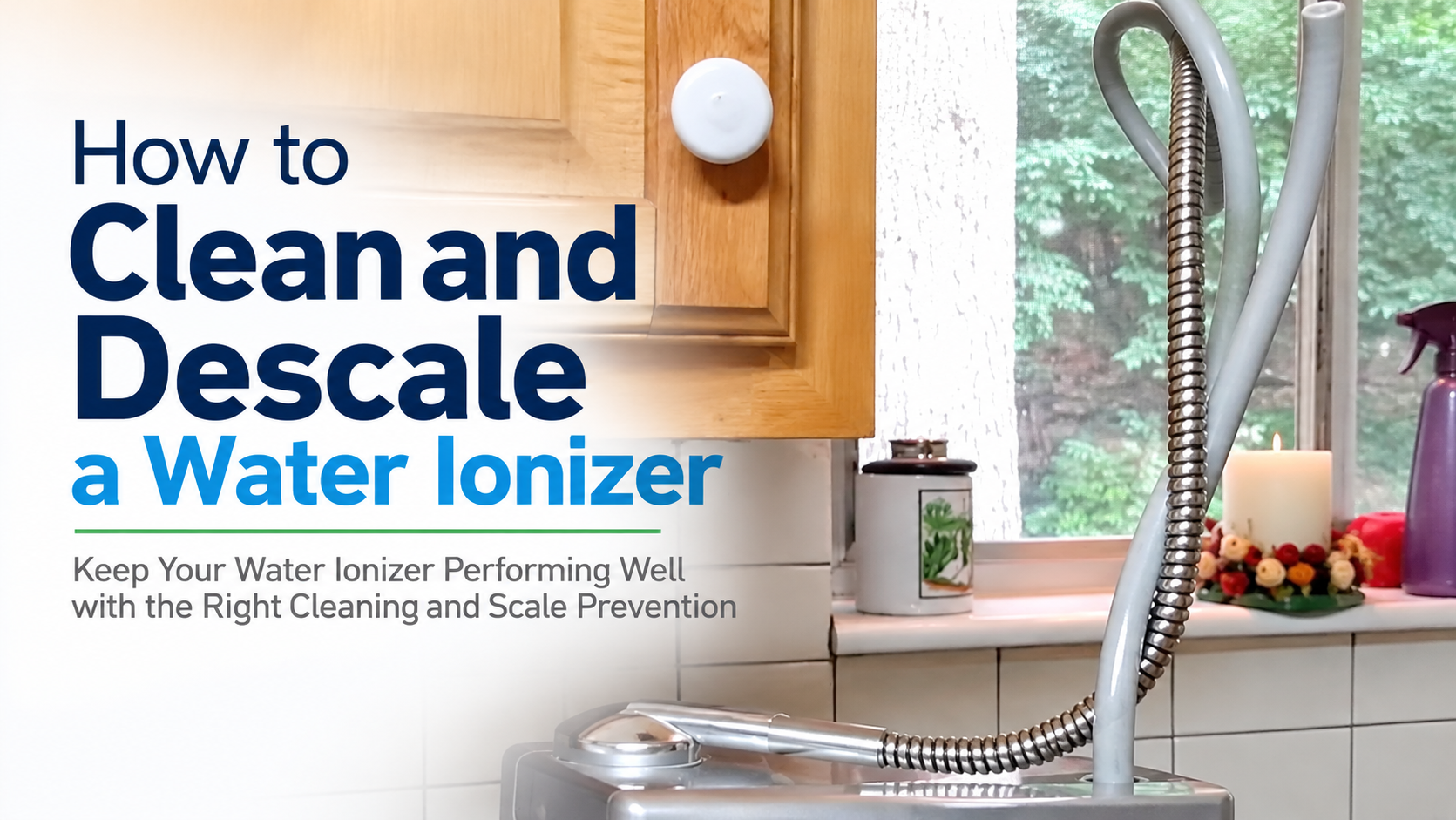
Why Descale a Water Ionizer?
Water ionizers are designed to clean their electrolysis chambers automatically, but that does not necessarily mean mineral scale can never accumulate inside the machine. If your source water contains significant hardness minerals—especially calcium and magnesium—those minerals can become concentrated during electrolysis and gradually form scale.
The good news is that proper water preparation, automatic cleaning technology, and occasional descaling when needed can help keep a water ionizer performing properly for many years.
How Do You Know It's Time to Clean Your Water Ionizer?
Possible signs of mineral-scale buildup include:
- Your alkaline-water pH isn't reaching the levels it normally does. If nothing else about your source water or settings has changed, mineral scale may be interfering with electrolysis.
- Water flow through the ionizer has gradually slowed. Scale can accumulate in internal waterways, fittings, hoses, valves, or the electrolysis chamber.
- You see a white or chalky mineral deposit around the alkaline-water spout. This is one of the easiest signs of calcium-scale formation to recognize.
- Your water is particularly hard. Hard-water users generally need to pay more attention to scale prevention than people with naturally soft or moderately hard water.
- It's been a long time since the ionizer was descaled. Depending on your water chemistry and scale-protection system, periodic preventive cleaning may be worthwhile even before performance noticeably declines.
Important: A decrease in flow is not always caused by scale. An exhausted or clogged water filter, sediment in a prefilter, low household water pressure, or another restriction can cause similar symptoms. Check the simple possibilities before assuming the electrolysis chamber needs cleaning.
Why Can a Self-Cleaning Water Ionizer Still Develop Scale?
Modern water ionizers may use automatic polarity reversal or other cleaning cycles to help prevent minerals from adhering to the electrode plates. This is extremely important because mineral-coated electrodes can reduce electrolysis performance.
However, an ionizer contains more than electrodes. Water also travels through tubing, valves, fittings, outlets, and other internal passages. Automatic electrode-cleaning technology cannot necessarily prevent every mineral deposit throughout the entire water pathway.
There is another reason alkaline water ionizers are particularly susceptible to calcium scale: electrolysis changes the mineral distribution of the incoming water. Calcium and other positively charged mineral ions tend to become more concentrated on the alkaline side of the electrolysis process. Consequently, scale may appear at the alkaline outlet or elsewhere along the alkaline-water pathway.
This doesn't mean calcium is bad. In fact, naturally occurring minerals are important to good ionization. The objective isn't to remove every mineral from the water; it's to provide the ionizer with water chemistry that allows effective electrolysis without excessive scale formation.
Hardness Matters More Than TDS
Older discussions about water ionizers often used TDS (total dissolved solids) as a shortcut for determining whether water was "hard." We now know that this can be misleading.
TDS tells you approximately how much dissolved material is in the water, but it doesn't tell you what those dissolved substances are. Two homes can have the same TDS reading and very different water chemistry.
For scale formation, hardness—particularly calcium and magnesium—is much more useful than TDS alone.
For example, water containing substantial calcium hardness can produce scale even if its overall TDS doesn't appear exceptionally high. Conversely, water can have high TDS because of other dissolved ions without having the same calcium-scaling potential.
If you're trying to determine how much scale protection your water ionizer needs, find out your:
- Total hardness
- Calcium hardness, if available
- pH
- Alkalinity
- TDS or conductivity as additional information
Your municipal water-quality report is a good starting point, but water chemistry can vary by location and season. A water test of the water actually entering your home provides even better information.
Preventing Scale Is Better Than Removing It
If you have hard water, don't wait until your water ionizer becomes badly scaled. Reducing scale formation in the first place is much easier on the machine.
Depending on your source-water chemistry, scale-control options can include:
- Using the ionizer manufacturer's recommended scale-protection system.
- Installing an appropriate hard-water pre-treatment system.
- Using an EOS Scale Guard where appropriate.
- Using reverse osmosis followed by proper remineralization when the source-water chemistry is unsuitable for direct ionization.
- Performing periodic descaling when your water conditions require it.
With current AlkaViva H2 Series ionizers, AlkaViva also offers a dedicated citric-acid cleaning system designed specifically to remove hard-water scale from the ionizer.
What About Reverse Osmosis Water?
Reverse osmosis can be extremely useful when the incoming water contains excessive hardness, salts, sodium from a conventional water softener, or other dissolved substances that make the water unsuitable for direct ionization.
However, very low-mineral RO water is not ideal for electrolysis by itself. If RO water is going to feed a water ionizer, it should be appropriately remineralized first.
Our Perfect & Pure Tankless Reverse Osmosis System includes remineralization, making it particularly useful where the original source-water chemistry needs substantial correction before the water reaches an ionizer.
What If Your Home Has a Sodium Water Softener?
A conventional ion-exchange water softener solves one problem very effectively: it removes calcium and magnesium hardness. It does this primarily by exchanging those hardness minerals for sodium ions.
That is excellent for preventing scale in household plumbing and appliances, but softened water is generally not the water chemistry I prefer to send directly into a water ionizer for drinking-water production.
If your entire home is already softened, one solution is to use an unsoftened cold-water line for the ionizer when the original water chemistry is suitable. Another is to use reverse osmosis after the softener and then remineralize the RO water appropriately before it enters the ionizer.
Should You Use Vinegar or Citric Acid to Clean a Water Ionizer?
Both white vinegar and citric acid dissolve calcium carbonate scale, which is why both have historically been used for descaling appliances and water equipment.
However, I no longer recommend treating one homemade vinegar-wash procedure as universal instructions for every brand and model of water ionizer. Internal designs differ, and manufacturers may specify a particular cleaning solution, cartridge, concentration, soaking time, and flushing procedure.
The safest approach is:
- Check the manufacturer's cleaning instructions for your particular model first.
- Use the manufacturer's cleaning cartridge or procedure when one is available.
- Never assume that a procedure developed for one ionizer is appropriate for another.
- Flush the machine thoroughly after any descaling procedure before drinking the water.
How Often Should You Descale a Water Ionizer?
There isn't one correct cleaning schedule for everyone because scale formation depends heavily on source-water chemistry and the type of scale protection being used.
Know your source water → choose the right pre-treatment → use the ionizer correctly → watch for signs of scale → clean when necessary.
That's a much better approach than relying on a fixed TDS number or waiting until water barely flows through the machine.
The Vinegar Wash Procedure:
What you will need:
- 10 oz. distilled white vinegar.
Basic Vinegar Wash Instructions for Water Ionizers:
- Take the alkaline and acid hoses and raise them to a position higher than the water ionizer. Prop them there.
- It's preferable to use your water ionizer's old [used up] filters for this.
- Use a funnel to pour white vinegar into one of the hoses until it comes out the other. This usually takes about 10 oz of vinegar.
- Let sit overnight or until unclogged/cleaned inside out.
- Lower the acid hose to the normal position.
- Run water through the ionizer.
- The vinegar may need additional time to dissolve heavy calcium buildup, and the procedure may need to be repeated. Repeat process if the ionizer is still clogged.
[Note: If you have a very clogged water ionizer…don’t worry if it is very slow-flowing or a trickle at first. The calcium build-up will eventually dissolve with this technique.]
Advanced Vinegar Wash for Direct-Plumbed Water Ionizers:
- Turn off the water shutoff, at the cold water line.
- Open up the flow-valve on the machine and disconnect the white hose from the shutoff.
- Take the three hoses: alkaline flexi-hose (spout), acid hose and water input hose and raise them all higher than the top of the machine. I would tape them together and prop them up somehow.
- Fill the machine with white vinegar: Use a funnel and start pouring white vinegar into the biggest hose. Continue until you see vinegar coming out of one of the other hoses. It will probably be about 8 ounces.
- Let it sit overnight with all hoses propped up so no vinegar leaks out.
- In the morning, lower one hose to your mouth level and agitate the vinegar by quickly pushing and pulling air through it (blowing/sucking). This agitation should break up the loosened calcium inside the line.
- Reposition that hose and refill any lost vinegar in the system and let it sit for another 24 hours.
- The next morning repeat #6.
- Then lower the three hoses and reconnect them to the water supply.
- Before turning the machine back on, rinse the vinegar out by pouring water through the unplugged machine for about a minute.
- Alternatively, refill it with vinegar and try again if it's still clogged.
Need Help With Your Particular Water Ionizer?
If you're unsure whether your ionizer needs cleaning—or whether your water requires additional scale protection—contact us. Tell us your water ionizer model and ZIP code, and we can help you determine the best approach for your water conditions.