Comparing Types of Hydrogen Water Machines
Published by Alkaline Water Plus
Updated August 21, 2026: Hydrogen water machines have changed considerably over the years. I've personally used and tested several different ways of producing hydrogen-rich water, including water ionizers, dedicated hydrogen water machines, hydrogen gas generators, and naturally ionizing filters. This guide explains how they differ, what I have measured in my own testing, and which type may make the most sense for different needs.
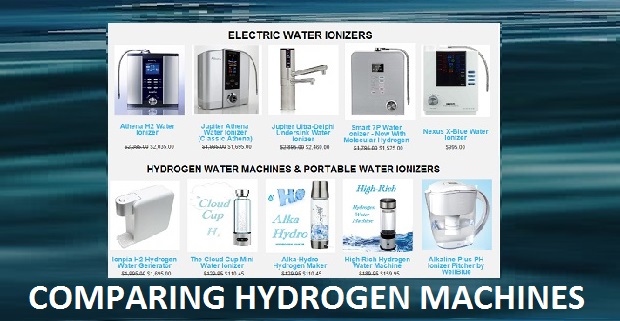
Hydrogen Water Machines Compared
| Type | Best For | Filters Water? | Changes pH? | Hydrogen Production |
|---|---|---|---|---|
| Water Ionizer | Daily drinking water for the whole family | Yes, depending on the model (See my water ionizer comparisons.) | Yes | Can be high |
| Dedicated Hydrogen Water Machine | Hydrogen-rich water without raising pH | Usually limited or none | No | Can be high |
| Portable Hydrogen Bottle | Travel or small individual servings | Usually limited or none | No | Varies considerably |
| Naturally Ionizing Filter or Pitcher | Lower-cost filtration with modest hydrogen production | Yes, but limited | Yes, but limited | Generally lower |
| Hydrogen Gas Generator | Hydrogen gas can be pumped into water, but this is clumsy and limited. | No | No | Varies by machine and method |
What Is Hydrogen Water?
Hydrogen water is water containing dissolved molecular hydrogen (H2). Molecular hydrogen has been studied for its potential antioxidant and biological effects, and research into hydrogen-rich water continues to expand.
Hydrogen gas is extremely small and escapes from water relatively quickly. For that reason, I prefer hydrogen water that is made fresh rather than water that has been sitting in an ordinary open or unsealed container for a long period of time.
If you want to learn more about the research, see my hydrogen water and ionized water research page.
Which Type of Hydrogen Water Machine Is Best?
There isn't one answer for everyone. It depends on whether you want hydrogen alone, filtration, alkaline and acidic water options, portability, or a system designed to serve the entire household.
1. Water Ionizers
Water ionizers can produce dissolved hydrogen while also filtering the incoming water and providing different pH levels. Unlike a dedicated hydrogen machine, an ionizer separates the water into alkaline and acidic streams.
A high-quality water ionizer can provide hydrogen-rich drinking water continuously rather than making one small batch at a time. Many people also appreciate having different alkaline levels for drinking and acidic water settings for non-drinking uses.
Filtration quality varies considerably between brands, so I consider filtration just as important as hydrogen production when comparing machines. See my water ionizer comparison page for the models I currently recommend.
2. Dedicated Hydrogen Water Machines
Dedicated hydrogen water machines are designed primarily to dissolve molecular hydrogen into water without intentionally raising the pH.
This can be a good choice for someone whose primary goal is hydrogen-rich water rather than the multiple water settings of a water ionizer.
One important consideration is filtration. Some hydrogen machines provide little or no meaningful filtration, so the quality of the water you put into the machine matters. If the unit doesn't provide adequate filtration, I recommend starting with appropriately filtered water.
3. Portable Hydrogen Water Bottles
Portable hydrogen bottles have become much more popular in recent years. Their biggest advantage is convenience: they make a small amount of hydrogen-rich water that can be used at home, at work, or while traveling.
However, hydrogen output, electrode quality, construction, cycle time, capacity, and durability vary widely. A high advertised hydrogen number doesn't automatically make one bottle better than another.
4. Naturally Ionizing Filters and Pitchers
Naturally ionizing filters and pitchers can provide filtration while also changing some characteristics of the water and, depending on the system and water chemistry, producing measurable dissolved hydrogen.
They generally don't produce hydrogen at the same levels as the strongest electronic ionizers or dedicated hydrogen machines, but they can be an economical option for someone who wants filtration and a simpler system.
5. Hydrogen Gas Generators
A hydrogen gas generator produces hydrogen gas that can be bubbled into water. Because the machine itself doesn't necessarily filter the water, filtered water should be used when making hydrogen-rich drinking water this way.
Hydrogen Water Machine vs. Water Ionizer: What's the Difference?
This is one of the most important distinctions to understand before buying.
A hydrogen water machine is primarily intended to increase dissolved molecular hydrogen in the water while generally leaving the pH close to where it started.
A water ionizer performs several functions at once. Depending on the model, it filters the water, electrolyzes it, produces dissolved hydrogen, and gives the user multiple alkaline and acidic water settings.
If your only goal is hydrogen-rich water, a dedicated hydrogen machine may be sufficient. If you want hydrogen along with high-quality filtration and multiple water settings for the household, a good water ionizer may make more sense.
How Can You Make Your Own Hydrogen Water?
The simplest approach is to use a water ionizer, dedicated hydrogen water machine, or portable hydrogen bottle designed to produce dissolved H2.
Because dissolved hydrogen gradually escapes from water, I recommend drinking hydrogen-rich water reasonably soon after making it. If you need to store it, a tightly sealed container designed to minimize gas loss is preferable to an ordinary open glass or bottle.
How Much Hydrogen Is in the Water?
Dissolved hydrogen is commonly measured in parts per million (ppm), which is equivalent to milligrams per liter (mg/L) for these purposes.
The amount produced by a machine can be affected by water chemistry, temperature, flow rate, operating time, electrode design, machine condition, and testing method. This is one reason I prefer actually testing machines rather than relying only on manufacturers' advertised numbers.
For my testing, I have used hydrogen test drops as well as the Trustlex molecular hydrogen meter.
My Hydrogen Machine Test Results
Over the years, I've personally tested different types of hydrogen-producing equipment. The results below are examples of measurements I obtained under the conditions noted. They should not be interpreted as guaranteed output under every water condition or operating environment.
Smart Water Ionizer
Test conditions: Continuous flow at approximately 1.5 liters per minute, Level 3.
- Hydrogen test drops: approximately 1.5 ppm
- Trustlex meter: approximately 1.5 ppm
- ORP measured in this test: approximately -800 mV
This illustrates one of the advantages of a strong water ionizer: hydrogen-rich water can be produced continuously while the machine also performs its other water-treatment functions.
Buder HS72 Hydrogen Water Machine
Buder HS72 Hydrogen Water Machine
This machine makes hydrogen water in batches rather than continuously. In my testing:
- Hydrogen test drops: approximately 1.3 ppm
- Trustlex meter: approximately 1.3 ppm
- ORP measured in this test: approximately -800 mV
Unlike a conventional water ionizer, this type of machine doesn't separate the water into alkaline and acidic streams and doesn't provide the same type of filtration.
High-Rich Hydrogen Machine
High-Rich Hydrogen Water Machine
In one of my tests using an approximately 8-ounce serving processed for five minutes:
- Hydrogen test drops: approximately 1.2 ppm
- Trustlex meter: approximately 1.35 ppm
- ORP measured in this test: approximately -700 mV
Hydrogen Gas Machine
This type of system produces hydrogen gas that can be introduced into water. In my testing:
- Hydrogen test drops: approximately 1.0 ppm
- Trustlex meter: approximately 1.35 ppm
- ORP measured in this test: approximately -800 mV
Because the hydrogen generator isn't being used as a water filter, I recommend starting with properly filtered water.
Elita Naturally Ionizing Filter
Elita Naturally Ionizing Filter
In my testing:
- Hydrogen test drops: approximately 0.3 ppm
- Trustlex meter: approximately 1.0 ppm
- ORP measured in this test: approximately -550 mV
The difference between the drop test and meter result is a good example of why hydrogen testing methods and testing conditions matter.
What Should You Look for Before Buying?
Hydrogen concentration is important, but I wouldn't choose a machine based on one advertised ppm number alone. I would consider the entire system:
- Actual dissolved hydrogen production rather than advertising claims alone
- Water filtration and which contaminants the filtration system is designed to reduce
- Continuous flow vs. batch production
- Water capacity and production time
- Electrode and cell quality
- Ease of cleaning and maintenance
- Replacement filter availability and cost
- Warranty and manufacturer support
- Whether you want pH adjustment or hydrogen production alone
Which Hydrogen Water System Would I Choose?
For someone who wants a complete household drinking-water system with filtration, hydrogen production, and multiple water settings, I generally prefer a high-quality water ionizer.
For someone who specifically wants molecular hydrogen without changing the pH of the water, a dedicated hydrogen water machine or a well-made hydrogen bottle may be the better fit.
For someone looking for a simpler and less expensive approach, a naturally ionizing filtration system may be worth considering.
The important thing is to compare what the machine actually does rather than assuming every product marketed as a "hydrogen water machine" is equivalent.
If you're considering a water ionizer, you can see my current recommendations and comparisons here:
Comparing Types of Hydrogen Machines: Video Demonstrations
These videos show several of the machines and testing methods I've used over the years. Some of the models shown are older, but the demonstrations are useful for understanding the differences between the technologies.
Earlier test results shown in these demonstrations: Nexus Smart water ionizer (approximately 1.5 ppm), SPE-270 hydrogen gas machine (approximately 1.5 ppm), Buder hydrogen water machine (approximately 1.2 ppm), High-Rich Machine (approximately 1.2 ppm), H2 tablets (approximately 0.7 ppm), Alkaline Ionizer Purifier Energizer (approximately 0.3 ppm), and Alkaline Plus pH Ionizing Pitcher (approximately 0.1 ppm).
Note: Hydrogen output varies according to the machine, water chemistry, temperature, flow rate, operating conditions, and testing method. The measurements above are results I obtained during my own testing and are not guarantees of the results every user will obtain. Information on this page is educational and is not intended to diagnose, treat, cure, or prevent disease.